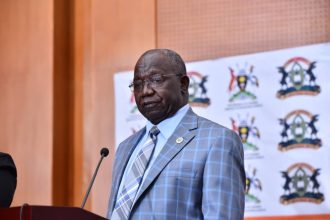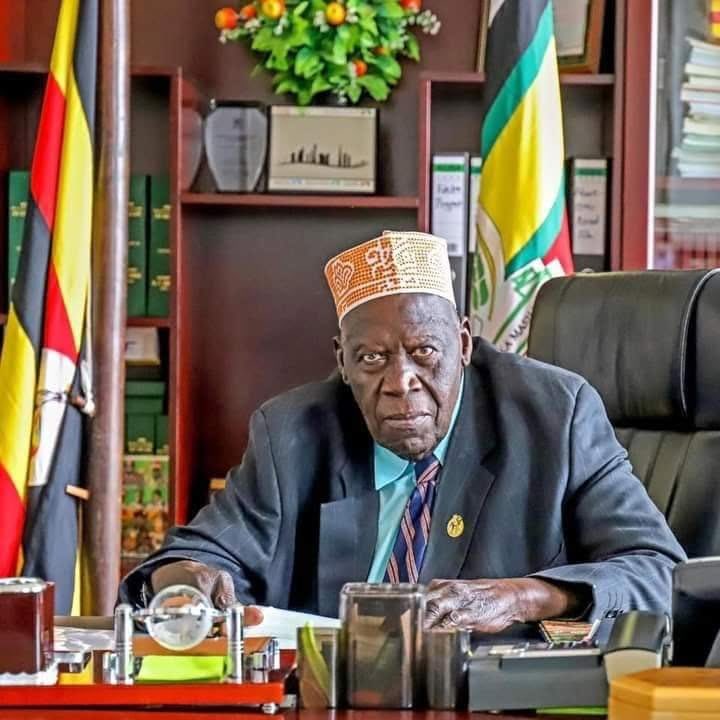
When a man spends over half a century in government, serves as Deputy Prime Minister, and collects more titles than a Nigerian prince has email scams, you can bet your bottom shilling he didn’t leave the party empty-handed.
Gen. Moses Ali, the lion of Adjumani who finally succumbed to the one adversary even a four-star general couldn’t outrun, Father Time, has left behind a financial legacy that’s as opaque as it is impressive.
Let’s be clear: precise net worth figures for Ugandan politicians are about as easy to pin down as the number of boda bodas in Kampala City.
But by connecting the dots in the farming empire, the political longevity, the perks of power, we can sketch a portrait of a man whose wealth was substantial enough to make even the most hardened sceptic raise an eyebrow.
The Foundations of a Fortune

Land, Lots of It
The core of General Ali’s wealth was his large-scale farming empire in the West Nile region . President Museveni himself, in his tribute, praised Ali as a “big modern farmer” .

In Ugandan political parlance, “big modern farmer” is code for “has enough land and enough government contracts to keep the tractors running”.
“In the West Nile region, he provided the good example of being a big modern farmer. We shall miss greatly his contribution.” – President Yoweri Museveni
When you’re in a position to advocate for infrastructure development – roads, electricity, the works, and your own farming interests stand to benefit handsomely, it’s what we in the business call a “synergy” .
The Salary of a Lifetime
Five decades of high-level government service come with a rather generous remuneration package. His roles included:
-
Minister for Finance (1975, under Idi Amin)
-
Minister for Tourism, Wildlife and Antiquities (1994)
-
Minister for Disaster Preparedness and Relief
-
Second Deputy Prime Minister and Deputy Leader of Government Business
These aren’t exactly volunteer positions. The salary alone, over 50+ years, would be enough to make a City banker weep with envy.
The Price of Political Longevity
The General’s refusal to retire, even as his health visibly declined, was a public lecture in understanding the fundamental maths of Ugandan politics: Power = Wealth = Power.
His frail appearance being cleared for a fifth term while seated in a vehicle in 2025 was a visual metaphor for a political machine that simply does not know when to quit.
His family was split ; the nation was divided; but the General was unmoved. In his own immortal words: “I am already retired by law as a General, what again do they want me to retire from?”
A fair point, if one overlooks the rather pressing matter of his health. But when the perks of office include:
-
A security detail that rivals the presidency
-
Access to government contracts
-
A salary that would keep a small village in beans for a century
…retirement suddenly seems like a rather poor career move.
While the exact numbers of his bank account remain a state secret – and will likely remain so unless his accountant has a sudden crisis of conscience, what is clear is that Gen. Moses Ali’s wealth was tied to his political power.
He was a man who benefited from a political culture where retirement is a suggestion rather than a requirement.
Estimated Net Worth of Gen. Moses Ali
What the State Paid
Before we get to the land and the investments, let’s start with the basics: the man drew a salary from the state for over fifty years, and not just any salary.
For decades, Gen. Ali sat in Parliament as an MP for East Moyo County and later Adjumani West. Being an MP in Uganda isn’t exactly a vow of poverty.
Reports from the Parliamentary Commission indicate that each MP is entitled to a consolidated pay package that includes a one-off car grant of Shs 200 million, a monthly gratuity of Shs 950,000, and a town run allowance of about Shs 1 million.
With sitting allowances, mileage, and other perks, some sources suggest an MP can take home anywhere between Shs 35 million and Shs 55 million in a single month.
The General got this, repeatedly, for longer than most of his constituents had been alive. Over a five-year term, one analyst estimated an MP could make between 4 to 5 billion shillings when all allowances are tallied up. Not a bad return on investment, if you can get it.
The Four Star Salary
The General’s uniform wasn’t just for show. As a four-star General, his salary was subject to the rather generous whims of the UPDF High Command.
According to reporting on military salary reforms, a four-star General’s monthly pay was raised from a rather modest 3.8 million shillings to a far more comfortable 15 million shillings.
But the real money for a retiring General isn’t in the monthly salary; it’s in the gratuity. When Generals retire, the state typically hands over a rather substantial package.
Reports from the recently banned Daily Monitor Newspaper indicate that for senior Generals, this includes Shs 250 million for a house and Shs 400 million in gratuity, practically a golden goodbye in a country with a GDP per capita of just over $1,000.
The Uganda Retirement Benefits Regulatory Authority has noted that the average retired Ugandan spends 10 to 17 years in retirement, which makes such a generous package all the more significant.
Beyond the Salary
The salary alone, impressive as it was, doesn’t tell the full story. A man doesn’t accumulate serious wealth on a civil servant’s wage, even a generous one. The real money was elsewhere.
At the core of General Ali’s wealth was his large-scale farming empire in the West Nile region. President Museveni himself, in his tribute, praised Ali as a “big modern farmer.”
He established Esia Mixed Farm after training in modern agriculture in Britain, and his demonstration farms attracted farmers from across the country seeking to learn modern practices. He grew cotton and other cash crops, inspiring many households in the region to move beyond subsistence farming.
The roads he tirelessly lobbied for didn’t just help his constituents; they helped his produce get to market faster and cheaper.
“In the West Nile region, he provided the good example of being a big modern farmer. We shall miss greatly his contribution. – President Yoweri Museveni
Land in Uganda is not just land bu a store of value, a source of income, and a symbol of status. Gen. Ali owned substantial tracts in and around Adjumani, including his ancestral home in Abiricaku Village, as well as property in Kampala. In a country where land prices have skyrocketed over the decades, this alone would constitute a significant chunk of his wealth.
The Access
This is where it gets tricky to quantify. The General had something money cannot buy: access.
As Deputy Prime Minister and a senior figure in the ruling NRM, he could open doors, smooth bureaucratic hurdles, and ensure that his business interests were never too badly inconvenienced by government policy. In Uganda, as in many places, it’s not what you know but who you know and Gen. Ali knew everyone who mattered.
His identity as a Nubian gave him a wider sphere of influence and, arguably, a greater level of protection. He authored a book on his people’s journey from soldiers of the British Empire to citizens of Uganda and Kenya. In politics, as in business, having a network that spans borders is never a bad thing.
The Nubian diaspora is a powerful political and economic force in East Africa, and Gen. Ali was one of its most prominent figures. This connection gave him a broader base of support, access to international networks, and a level of prestige that transcended Ugandan politics.
Conservative estimates put it somewhere between $5 million and $10 million, a fortune built on land, political connections, and the simple fact that in Uganda, being a four-star general who is also a Deputy Prime Minister is a business model in itself.
The Biggest Take Aways
-
Official Salary: Over Shs 25 million monthly as an MP, plus Shs 15 million monthly as a four-star General, with allowances pushing the total far higher.
-
MP Car Grant: A one-off Shs 200 million upon taking office.
-
Retirement Gratuity: A substantial package for senior Generals, reportedly including Shs 250 million for housing and Shs 400 million in gratuity.
-
Farming Empire: Large-scale agricultural operations in West Nile, significantly boosted by government infrastructure projects.
-
Land Holdings: Substantial property in Adjumani and Kampala.
-
Political Access: Invaluable connections that smoothed the path for his business interests.
Disclaimer
The article attempts to estimate the net worth of a man who spent five decades in government and was notoriously tight lipped about his finances.
The figures herein are pieced together from public records, parliamentary reports and informed guesswork.
If the late General’s family takes issue with any of this, we invite them to produce his bank statements.
The estimated net worth of $5-10 million is based on publicly available information and should be taken with a pinch of salt, or perhaps an entire salt mine.
The General’s actual wealth could be considerably higher, or considerably lower, given the opaque nature of Ugandan political finances.