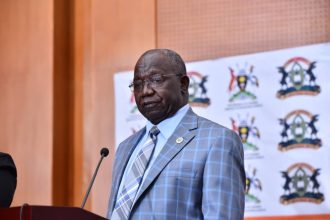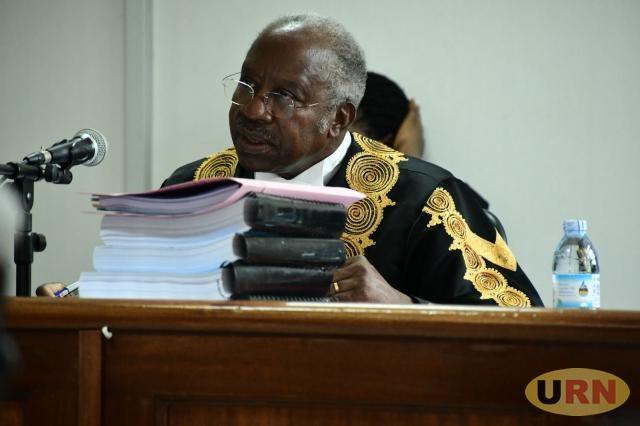
The Court of Appeal Justice Fredrick Egonda-Ntende has warned that Uganda risks sliding deeper into militarism and creeping authoritarianism if constitutional safeguards are not upheld and civilian authority over the military is not restored.
Justice Egonda-Ntende made the remarks during the inaugural Sam Kalega Njuba Memorial Lecture on September 18, 2025, where he cautioned that the country’s democratic foundation is being steadily undermined by unchecked executive power and the expanding role of the military in civilian affairs.

Delivering the keynote address under the theme “Remodelling Our Constitutional Framework,” the senior judge drew parallels between Uganda’s constitutional trajectory and the leadership of George Washington, the first President of the United States. Washington, who led the Continental Army during the American Revolutionary War, voluntarily relinquished power after the war and declined a third presidential term actions that reinforced the principles of civilian control and limited executive authority.
Justice Egonda-Ntende emphasized that these principles were echoed in Uganda’s 1995 Constitution, which was crafted to prevent the overconcentration of power and to ensure the military remained subordinate to elected civilian leaders. “Firstly, civilian control of the army. Secondly, the question of not allowing an elected leader to turn into a semi-monarch hence term and age limits that were instituted,” he said.
He warned that the Constitution must ensure a balance of power between different arms of government, cautioning against any one institution becoming dominant. His comments come amid growing concerns over the military’s involvement in governance, from law enforcement and public administration to overt political influence.
Opposition leaders have long accused President Yoweri Museveni, who has ruled since 1986, of dismantling civilian rule through constitutional amendments and militarization of the state. The 1995 Constitution once hailed as a progressive charter has been significantly altered. Term limits were removed in 2005, and age limits were scrapped in 2017, allowing Museveni to extend his presidency indefinitely.

Justice Egonda-Ntende described these amendments as a betrayal of the Constitution’s founding vision. He also criticized the expanding size of Parliament, the growing number of administrative districts, and the soaring cost of governance, all of which he said have weakened public service delivery and accountability.
He further condemned the use of military courts to try civilians, particularly opposition politicians, arguing that such practices erode the rule of law and entrench authoritarianism. “Perhaps the time has come for a civil society-led review of the current constitutional apparatus to determine whether it remains fit for purpose,” he said, urging the Uganda Law Society to take the lead in initiating reforms.
Justice Egonda-Ntende’s concerns are shared by leading legal professionals. Counsel Ronald Wanda, who represents opposition figure Dr. Kizza Besigye, cited Article 208(2) of the Constitution, which states that the Uganda People’s Defence Forces must remain subordinate to civilian authority. Human rights lawyer Eron Kiiza added that militarism is fundamentally incompatible with democracy and warned against allowing soldiers to determine the political direction of the nation.
Over the years, the military has played an increasingly visible role in Uganda’s politics. Armed soldiers stormed Parliament during the 2017 debate on age limits, and in 2005, the army raided court premises to re-arrest Besigye. Military officers continue to hold top positions in civilian ministries and public programs, raising concerns about blurred lines between security forces and government.
President Museveni has often dismissed constitutional limitations, once stating that the Constitution is merely a “piece of paper” that cannot override the “interests of the people.” Critics argue such remarks justify executive overreach and weaken public trust in the legal framework.
Justice Egonda-Ntende urged civic and professional bodies including doctors, engineers, farmers, and business associations to join efforts in defending the Constitution and safeguarding democratic governance. He called on the Uganda Law Society to champion this movement and honour the legacy of Sam Kalega Njuba, a key architect of the 1995 Constitution.
“If the Uganda Law Society can lead this effort,” he said, “the lifetime work of Sam Kalega Njuba for a free and democratic Uganda, where the rule of law prevails, will not have been in vain.”
As Uganda nears four decades under President Museveni, Egonda-Ntende’s words have reignited public debate over whether the country can reclaim its democratic path or whether the Constitution will continue to be bent in service of unchecked power.