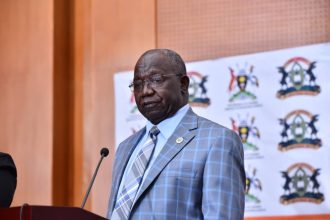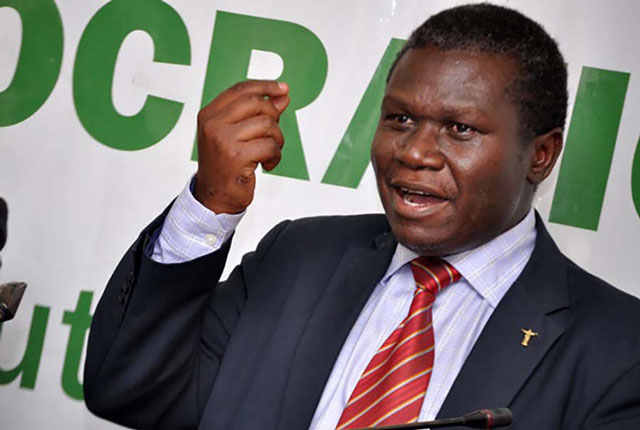
The Minister of Justice and Constitutional Affairs, Norbert Mao, who also serves as the President General of the Democratic Party (DP), picks nomination forms today to contest in the 2026 presidential election. In doing so, he steps into a political arena that is both familiar and deeply ironic.
Mao is no stranger to presidential politics. He previously ran in 2011, earning just over 147,000 votes—about 1.9% of the total—and finishing a distant fourth behind President Yoweri Museveni, Dr. Kizza Besigye, and even Olara Otunnu, a candidate whose campaign lacked widespread appeal and who famously couldn’t vote for himself.
The parallels between Mao and another former DP leader, the late Paul Kawanga Ssemogerere, are hard to ignore. Thirty years ago, Ssemogerere also transitioned from government to opposition, having served in Museveni’s broad-based cabinet as Minister for Internal Affairs and later Foreign Affairs before resigning in 1995 to contest the presidency.
The comparison, however, also reveals sharp contrasts. Ssemogerere stepped down from government to position himself as a principled opposition figure. Mao, by contrast, is launching his presidential campaign while still serving in Museveni’s cabinet—a move that has drawn criticism, raised questions about his credibility, and exposed the fractures within his party.
Many DP loyalists see Mao’s continued role in government as self-serving. Even before his appointment, Mao’s leadership had sparked internal dissent, with defections and public criticism weakening the party’s grassroots structures. His 2022 cooperation agreement with the ruling National Resistance Movement (NRM), which saw him appointed as Minister of Justice and Constitutional Affairs, only deepened these divisions.
Former DP legislator Betty Nambooze once described Mao as a “pumpkin”—green on the outside for DP, yellow on the inside for NRM. Her metaphor reflects a widespread sentiment among party members: that Mao’s alliance with Museveni has eroded the DP’s identity as an opposition force.

The party has seen a wave of high-profile defections, the most notable being Dr. Michael Lulume Bayigga in June 2025, following the controversial Mbarara Delegates Conference. Many of those who left have gravitated toward Robert Kyagulanyi Ssentamu’s National Unity Platform (NUP), which has rapidly grown into Uganda’s most prominent opposition platform.
Mao defends his position as pragmatic engagement, arguing that influencing governance from within is more effective than shouting from the sidelines. Yet the optics are difficult to manage. He now presides over a justice system he once criticized, while simultaneously presenting himself as an opposition candidate.
This contradiction weakens his political narrative. How can one credibly challenge electoral malpractice while still serving in the cabinet responsible for overseeing the electoral process?
His earlier presidential run in 2011 showcased his abilities as a sharp debater and legal mind, capable of articulating nuanced positions on constitutional matters. But it also exposed his weaknesses—most notably his inability to build a robust national campaign network or mobilize voters beyond his regional base.
Fifteen years later, these structural limitations remain. The Democratic Party is more fractured than ever, and the opposition space is now dominated by younger, more assertive voices.
The irony deepens when one considers Mao’s current ministerial portfolio. As Justice Minister, he is responsible for upholding the legal and governance systems of the very administration he now seeks to replace. For many Ugandans, this dual role is simply irreconcilable.
Mao’s 2026 bid thus epitomizes the contradictions of Uganda’s political landscape. Unlike Ssemogerere, who distanced himself from government to challenge the system, Mao straddles both sides—a strategy that risks alienating voters and undermining public trust.
For some observers, Mao’s candidacy borders on political theatre—not due to a lack of intellect or experience, but because the image of an “opposition candidate” working from within Museveni’s government stretches public belief.
In reality, Mao’s run may do little to disrupt the status quo. Whether intended or not, his presence on the ballot could fragment the opposition vote further and reinforce the dominant narrative that Uganda’s political contest is controlled, not competitive.
What lies ahead may not be a campaign for change, but a calculated performance in a system that benefits most from managed dissent.