(JUBA) – Members of the Transitional National Legislative Assembly (TNLA) have renewed calls for the government to take full control of South Sudan’s mining sector. They argue that nationalisation of minerals, especially gold, could strengthen the economy and help stabilise the South Sudanese pound, which has been under pressure due to inflation.
The debate emerged this week as lawmakers discussed President Salva Kiir’s address during the opening of the first parliamentary session. Several legislators stressed that South Sudan’s long term economic future depends on careful management of natural resources and ensuring that revenues are directed towards national development.
Susan Thomas, a representative of Ezo County under the SPLM, said South Sudan’s mineral wealth was being exploited by private companies and foreign actors with little benefit reaching local communities. She urged the government to take direct ownership of the sector.
“Our country is rich in minerals across several states, but they are being extracted by private operators and even foreigners,” she said. “If the government nationalises the mining sector, it can strengthen the economy, particularly the South Sudanese pound. Gold could serve as a reserve vault and legal tender to help address the current economic crisis.”
At the official exchange rate in August 2025, one US dollar is equivalent to about 4,600 South Sudanese pounds.

Supporters of nationalisation argue that gold reserves could provide a stable financial buffer, reduce reliance on oil revenues, and help diversify the economy. Oil remains South Sudan’s main source of revenue, but lawmakers stressed that broadening the resource base is critical.
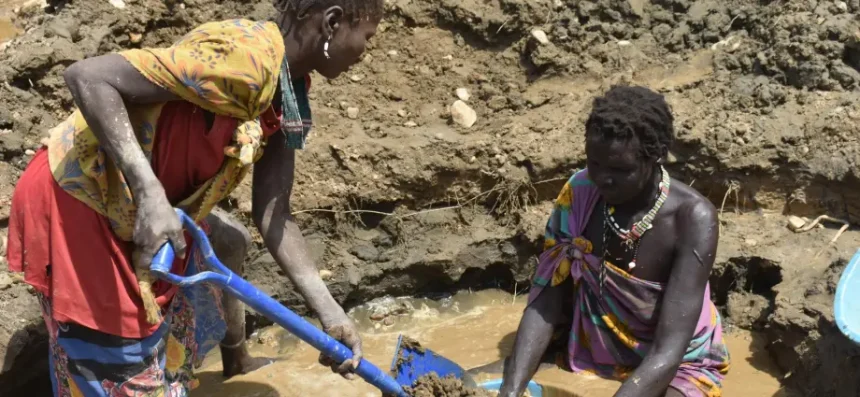
The mining sector in South Sudan has long suffered from weak regulation, unclear licensing systems and unmonitored extraction. These conditions have allowed unregulated private operators, often in partnership with foreign companies, to profit without contributing meaningfully to development in host communities.

Susan Thomas also criticised government dependence on imported commodities, including drinking water, despite the country’s natural resources. Referring to the River Nile, she called on the Ministry of Water and Irrigation to present a detailed action plan before the next budget session.
“We have water available in the Nile, yet we are buying water from foreign suppliers,” she said. “The ministry should prepare a clear action plan ahead of budget discussions.”
Other lawmakers echoed her concerns. Nadia Arop, representing Unity State, said parliament must prioritise implementing existing presidential directives rather than only making new policy suggestions.
“If we do not address the problem of implementation, we will sit each year to discuss the president’s speech with no tangible results,” she said.
However, some observers caution that nationalisation alone may not be enough. Without strong institutions, transparent management, and accountability mechanisms, the process could risk reinforcing political control over resources rather than delivering benefits to citizens.
PS: This mining sector article was first published by Jakony Media Agency, South Sudan’s largest business news website and portal.