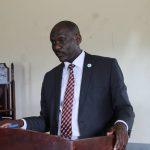
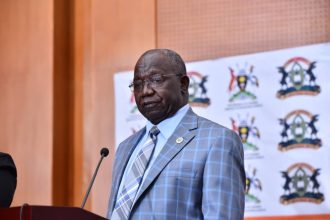
The Rubanda District Assistant Resident District Commissioner (RDC), Mr. Martin Turyagyenda, has threatened tough action against health facilities implicated in the embezzlement of government-supplied medical equipment.
Mr. Turyagyenda made the remarks on December 19 during a one-day district feedback meeting held at the district production hall. The meeting followed a data-collection exercise conducted in eight health facilities across Rubanda District.

The meeting was organised by Kigezi Orphans and Vulnerable Children Living with HIV/AIDS (KADOLHA) in partnership with Mayanja Memorial Hospital Foundation, with funding from the TASO Global Fund.
Addressing participants, Mr. Turyagyenda warned health facility staff involved in embezzlement against spending the festive season enjoying luxuries while medical equipment meant for patients remains missing. He urged those responsible to replace the stolen equipment, stressing that failure to do so would result in arrests and prosecution.
“As the President’s representative in the district, I will not hesitate to take action, including arrests, to ensure the recovery of stolen medical equipment,” he said.
The Assistant RDC also raised concern over health worker absenteeism, noting that it continues to undermine effective service delivery in public health facilities.

Meanwhile, Mr. Eli Mucunguzi, the District Principal Assistant Secretary, representing the Chief Administrative Officer (CAO), acknowledged that understaffing remains a major challenge affecting health service delivery. He revealed that patients spend more than two hours waiting for services, instead of the recommended 30 minutes, largely due to limited staffing levels.
Mr. Amos Tugumisirize, the Executive Director of KADOLHA, said the assessment covered eight government health facilities, including Muko Health Centre IV, Hamurwa Health Centre IV, Ruhija Health Centre III, Bubare Health Centre III, Bwindi Health Centre III, Bufundi Health Centre III, Mpungu Health Centre III, and Ikumba Health Centre III.
He noted that the study revealed persistent challenges such as long patient waiting times, drug stock-outs, limited access to CT scans, and inadequate staffing, disproportionately affecting people living with HIV/AIDS and other patients seeking medical services.