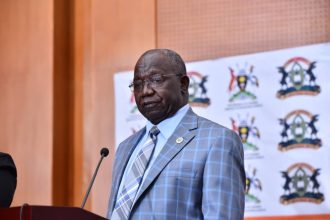

General Katumba Wamala’s appointment as Minister of Public Service comes at a time when the ministry is reeling from scandals involving ghost workers, pension fraud, and wage overruns. Recent audits revealed over UGX 24 billion lost to ghost employees and nearly 24,000 suspected ghost pensioners costing the state UGX 98 billion annually.
Against this backdrop, Katumba’s military discipline, reformist record, and loyalty to President Museveni make him a formidable choice to restore credibility.
Uganda’s Public Service has long been plagued by inefficiency and corruption. The Auditor General’s 2023 report exposed UGX 24 billion paid to ghost employees across 367 government entities, with 6,307 dead or retired individuals still drawing salaries. Overpayments of UGX 62.6 billion and underpayments of UGX 78.2 billion further highlighted systemic payroll dysfunction.
District-level audits in 2024 found 5,358 ghost workers who had absconded from duty for years but continued to earn salaries. Pension scandals have been equally damaging. In 2019, the Ministry of Public Service flagged 24,143 ghost pensioners, costing the Treasury an estimated UGX 98 billion annually. These figures illustrate the scale of dysfunction Katumba must confront.
Historical parallels show that Uganda has faced similar crises before. In the early 2000s, payroll scandals undermined trust in the police, prompting reforms under Katumba when he served as Inspector General of Police. His insistence on discipline and accountability reduced corruption and restored some credibility to the force.
Likewise, his leadership as Chief of Defence Forces during the fight against the Lord’s Resistance Army demonstrated his ability to impose order in chaotic environments. These experiences suggest he can replicate reform in Public Service, where entrenched corruption networks are deeply embedded, resistant to change, but not invincible under disciplined leadership.
Katumba’s profile underscores why Museveni trusts him with this poisoned chalice. Born in 1956 in Kalangala, he rose through the ranks to become Uganda’s only Muganda four-star general. His training in Tanzania, Nigeria, and the United States gave him strategic leadership skills. He commanded UPDF forces in the Democratic Republic of Congo, led peacekeeping missions in Somalia, and helped modernise Uganda’s army.

His tenure as Minister of Works and Transport saw him push for infrastructure development despite resource constraints. His survival of the 2021 assassination attempt, which claimed the lives of his daughter and driver, cemented his image as a resilient soldier who has sacrificed for Uganda.
Museveni’s reliance on Katumba reflects both loyalty and competence. In a political environment where tribalism often undermines governance, Katumba’s rise as the only Muganda four-star general signals Museveni’s confidence in his ability to transcend ethnic divides. His loyalty is forged through decades of service, not opportunism.
For Museveni, Katumba is not just a soldier but a trusted reformer who can impose discipline in a ministry synonymous with dysfunction.
The challenges ahead are immense. Katumba must digitise payroll systems to eliminate fraud, enforce biometric validation to prevent ghost pensioners, and restore morale among civil servants. He must also balance reform with political realities, ensuring Museveni’s broader agenda of stability is not undermined.
Yet his track record suggests he is uniquely equipped for the task. His military discipline can root out fraud; his reformist experience can modernise bureaucracy; his loyalty ensures alignment with Museveni’s vision; and his resilience inspires confidence in a demoralised civil service.
In conclusion, Katumba Wamala’s appointment is a calculated gamble by Museveni. The statistics are damning—billions lost to ghost workers and pension fraud—but Katumba’s career shows he thrives in times of crisis. His blend of discipline, reformist zeal, and loyalty makes him the right bet to rehabilitate Public Service.
If he succeeds, he will not only restore credibility but also cement his legacy as one of Museveni’s most trusted reformers. If he fails, the ministry risks sinking deeper into dysfunction. But given his history, Uganda has reason to believe that General Katumba Wamala will rise to the challenge, turning a scandal-ridden ministry into a pillar of reform and accountability.
The writer is a former Gomba East MP aspirant and Deputy RCC, Nyendo-Mukungwe.