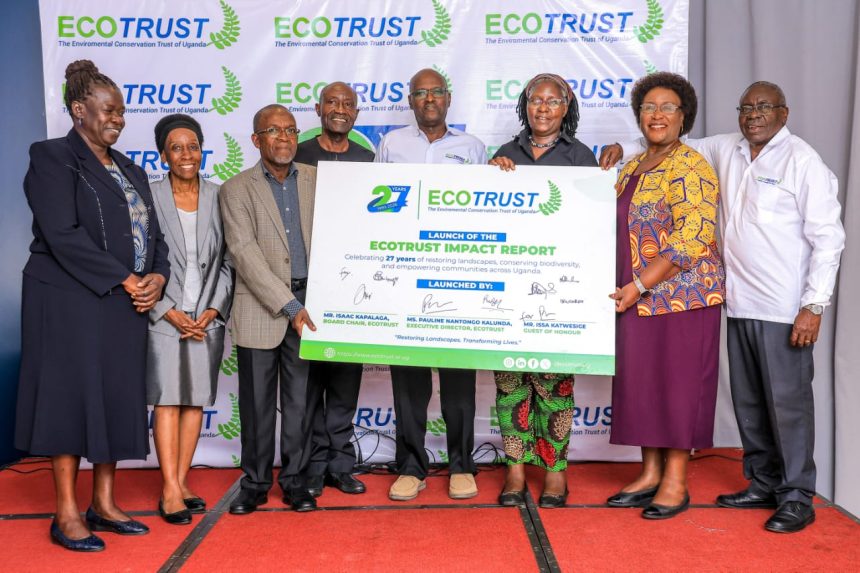
Environmental Conservation Trust of Uganda said on Tuesday it is increasingly relying on carbon markets and private climate financing as Uganda grapples with rising deforestation and land degradation pressures.
The organisation said about 80% of its funding now comes from private philanthropy, conservation service agreements and its Endowment Fund, marking a shift away from traditional donor dependence.
The disclosure was made during the launch of ECOTRUST’s 27th anniversary celebrations at Golden Tulip Canaan Kampala.
Founded in 1999 following the transformation of a former environmental grants management unit supported by United States Agency for International Development, ECOTRUST has grown into one of Uganda’s conservation financing institutions working at the intersection of climate action and rural livelihoods.
The organisation’s flagship “Trees for Global Benefits” programme, launched in 2003, links smallholder farmers to voluntary carbon markets while promoting land restoration and income generation through tree planting and agroforestry systems.

Executive Director Pauline Nantongo Kalunda said the model is designed to make conservation economically viable for rural households rather than relying on donor-driven incentives.
“We want farmers to grow trees because it makes economic sense for them, not simply because they are saving the environment,” Nantongo said.

“When environmental services such as carbon storage, watershed protection and climate regulation are properly valued, conservation becomes a profitable and sustainable land-use option,” she added.
The organisation said it currently works with more than 54,000 households and supports the restoration and management of over 70,000 hectares of land across five major landscapes, including Queen Elizabeth, Rwenzori Mountains, Mount Elgon, Murchison Falls and Mpologoma.
Carbon markets and nature-based financing schemes have expanded across Africa in recent years as governments and private investors seek climate solutions that combine emissions reduction with land restoration. However, such mechanisms continue to face scrutiny over pricing fairness, long-term sustainability and benefit-sharing with local communities.
ECOTRUST said its restoration model supports a range of income-generating activities including timber production, coffee and cocoa farming, fruit growing, honey production, fish farming and fuel wood production, alongside carbon and biodiversity credit financing.
Board Chairperson Isaac Kapalaga said the organisation remains focused on expanding its reach despite operational challenges in scaling conservation programmes across multiple regions.
“Our commitment remains focused on reaching more communities and ensuring that conservation delivers real social and economic value to ordinary Ugandans,” Kapalaga said.
Uganda continues to face environmental stress driven by deforestation, population pressure and land degradation, with government and private sector actors increasingly turning to restoration and climate finance as part of national climate resilience strategies.
ECOTRUST said it aims over the next five years to improve livelihoods and climate resilience for more than 16.5 million people across 33 districts while restoring at least 60,000 additional hectares of degraded land.