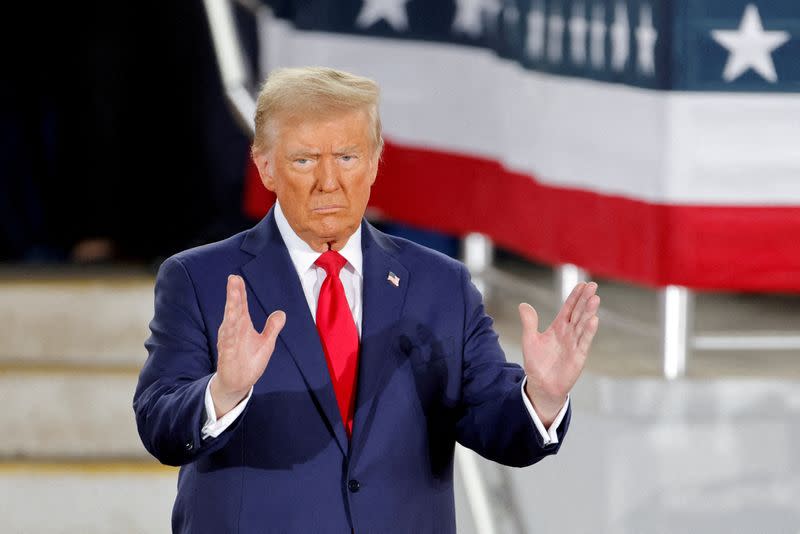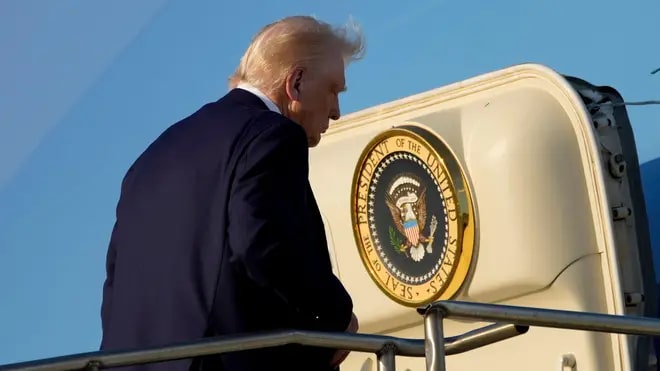

US President Donald Trump has said that the UK is “out of line” but suggested a deal could still be worked out, while warning that the European Union (EU) should expect tariffs “pretty soon” as part of his economic agenda. He added that imposing tariffs on the UK “might happen,” though it remains unclear when or how.
This comes after China, Canada, and Mexico vowed retaliatory measures against the US over its sweeping tariffs on goods.
“The UK is way out of line, and we’ll see,” Trump said as he returned to Washington. “But the European Union is really out of line. The UK is out of line, but I’m sure that one can be worked out. But the European Union, it’s an atrocity what they’ve done.”
Trump continued, stating, “The United States has been ripped off by virtually every country in the world. We have deficits with almost every country—not every country, but almost—and we’re going to change it. It’s been unfair.”
Regarding the UK, Trump said, “It might happen [with Britain], but it will definitely happen with the European Union. I can tell you that because they’ve really taken advantage of us. We have over a $300 billion deficit.”
Trump’s tariffs on China, Canada, and Mexico fulfill one of his campaign promises to voters, but they have thrown the global economy into turmoil, complicating his political mandate to lower prices.
Both Canada and Mexico have responded by preparing similar tariffs on US goods, while China has vowed to take “necessary countermeasures to defend its legitimate rights and interests.”

On Saturday, Canadian Prime Minister Justin Trudeau announced that Canadian duties on $30 billion (£24 billion) worth of American goods, including alcohol and fruit, would take effect on Tuesday when the US tariffs go into effect.
He opened his address to Canadians with a message aimed at American consumers: “It will have real consequences for you, the American people,” he said, noting that it would result in higher prices for groceries and other goods.
Mr. Trudeau channeled the sentiments of many Canadians who felt betrayed by their longtime ally, reminding Americans that Canadian troops had fought alongside them in Afghanistan. “The actions taken today by the White House split us apart instead of bringing us together,” Mr. Trudeau said, warning in French that it could lead to “dark times” for many people.
Mexican President Claudia Sheinbaum said she had instructed her economy secretary to implement retaliatory tariffs and other measures in defense of Mexico’s interests.
“We categorically reject the White House’s slander that the Mexican government has alliances with criminal organizations, as well as any intention of meddling in our territory,” Ms. Sheinbaum wrote on X. “If the United States government and its agencies wanted to address the serious fentanyl consumption in their country, they could fight the sale of drugs on the streets of their major cities, which they don’t do, and the laundering of money from this illegal activity that has done so much harm to their population.”
Trump’s order includes a mechanism to escalate the rates if the countries retaliate against the US. The tariffs risk creating an economic standoff with America’s two largest trading partners, Mexico and Canada, upending a decades-old trade relationship and potentially triggering harsh reprisals from those nations.
The tariffs could significantly worsen inflation, eroding voters’ trust in Trump’s ability to fulfill his promise of lowering the prices of groceries, gas, housing, vehicles, and other goods.
Trump declared an economic emergency to impose a 10% duty on all imports from China and 25% on imports from Mexico and Canada. Energy imports from Canada, including oil, natural gas, and electricity, would be taxed at a 10% rate.
The tariffs are set to go into effect on Tuesday, leading to a showdown in North America that could undermine economic growth.
A new analysis from the Budget Lab at Yale predicted that the tariffs could cause the average US household to lose the equivalent of $1,170 (£943) in income due to the taxes.
David Eby, Premier of the Canadian province of British Columbia, called for a boycott of liquor from US “red” states in response to the tariffs. “It’s a declaration of economic war against a trusted ally and friend,” Mr. Eby said. “Effective today, I have directed BC liquor sales to stop buying American liquor from red states.” He added that employees would remove the most popular brands from government store shelves.
A senior US administration official, speaking anonymously, said the lower rate on energy was meant to minimize disruptive increases in the price of gas and utilities, acknowledging the risks to inflation. Price spikes under former President Joe Biden led to voter frustration that helped propel Trump back to the White House.
The order signed by Trump does not include a mechanism for granting exceptions, which could be problematic for industries like homebuilders who rely on Canadian lumber, as well as farmers, automakers, and other sectors. The order would also allow for tariffs on Canadian imports under $800 (£645), which are currently exempt from customs duties.