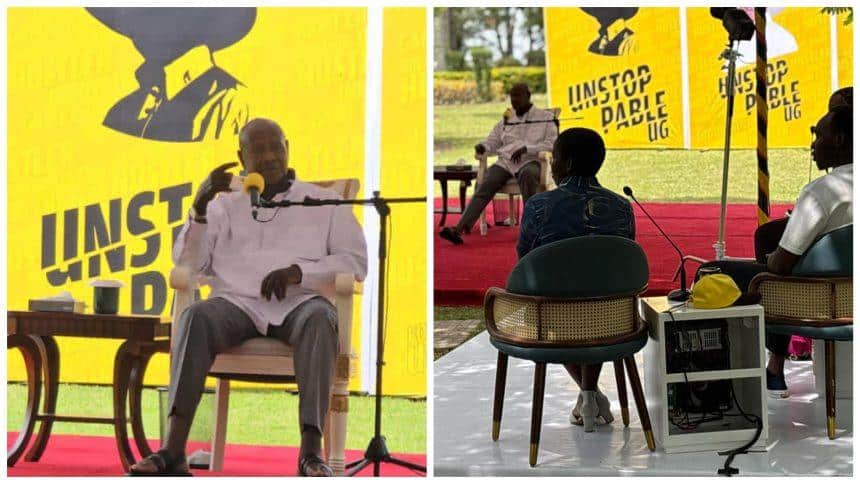
President Yoweri Kaguta Museveni on November 30, 2025, held an energetic and informal engagement with Gen Z youths at his Rwakitura ranch, under the #UnstoppableUG campaign. The youth-led initiative, which ran parallel to the NTV presidential debate, sought to create a relaxed space for the President to interact directly with young Ugandans on national challenges and opportunities.
The session—styled as a special “Sevo Café” edition—featured candid exchanges, bursts of humor, and a strong emphasis on hard truths about Uganda’s economic direction. It was broadcast across major TV stations and social media platforms, attracting wide online traction and hundreds of thousands of views.
From the onset, Museveni set a conversational tone, greeting the panel as his “Bazzukulu” and urging them to “wake up” and seize the opportunities available in the economy.
“Sometimes you go into sleep and disorientation,” he warned. “I’m here to tell you the reality.”
Key Focus: Wealth Creation and Ending Africa’s ‘Hemorrhage’
Responding to the question on how Uganda can move from a $60 billion to $500 billion GDP by 2040, Museveni simplified the economy into four wealth-creating sectors—commercial agriculture, manufacturing/industries, services, and ICT.

He emphasized that Uganda is uniquely endowed to excel in all four.
“Some countries like Japan have no land, so they rely only on the knowledge economy. But here, we have everything—agriculture, minerals, services, ICT. You can come in wherever you want.”

He revisited the 4-acre model, praising farmers who are already earning billions from small parcels of land through high-value enterprises such as coffee, fruits, dairy, poultry, piggery, and fish farming.
A major portion of his address focused on Africa’s economic loss through exporting raw materials.
Using his cotton shirt as an example, Museveni broke down how Uganda earns only $1 from exporting one kilo of raw cotton, yet the same kilo, when processed into garments locally, can be worth $15 and create multiple layers of jobs.
“The biggest donors in the world are African countries,” he said. “You donate wealth and jobs when you export raw materials. This is the hemorrhage.”
He defended import taxes as a necessary tool to protect local industries from being overshadowed by foreign products.
“We are not a supermarket for foreign goods,” Museveni told the panel. “We are a productive society.”
But he clarified that internal trade remains tax-free:
“If you buy my bananas here and take them to Kampala, there is no tax. There is no tax on agriculture. The tax is only on imported consumer items.”
Youth Questions: Jobs, Taxes, Representation and Health
The panel of Gen Z hosts and entrepreneurs did not shy away from pointed questions. They asked about tax burdens on small businesses, job scarcity, and the perception that youth engagements often feature “selected” participants rather than ordinary hustlers.
Museveni encouraged young people to embrace vocational skills and use government programs like PDM, Emyooga, and Operation Wealth Creation to build capital.
He promised broader, grassroots engagements:
“We shall involve all categories. The real hustlers must also be heard.”
On health issues such as measles outbreaks, Museveni emphasized immunization and pledged continued interventions, including providing anti-tick drugs for farmers.
A Meeting of Energy and Political Messaging
The event mixed music, youthful lingo such as “clock it”, and light-hearted banter—yet Museveni consistently pulled the conversation back to economic discipline. He cautioned against alcohol abuse, shortcuts to wealth, and consumerist lifestyles that undermine long-term progress.
The youth presenters described themselves as dreamers, hustlers, and innovators. Museveni agreed—so long as they ground their dreams in practical sectors that grow national wealth.
The online reaction was divided between praise for the President’s accessibility and criticism that the panel did not fully represent everyday Gen Z experiences. Still, the engagement reinforced Museveni’s pitch to young voters: ideological stability, unity, and wealth creation through production.