East Africa is witnessing one of the most significant wealth transitions in its history. Across Uganda, Kenya, Tanzania and Rwanda, thousands of businesses founded in the 1970s, 1980s and 1990s are approaching a defining moment. The entrepreneurs who built these enterprises through determination, sacrifice and resilience are beginning to hand over leadership to a new generation.
This transition presents an enormous opportunity. It also carries enormous risk. The greatest threat facing family wealth today is not taxation, inflation, market volatility or even economic uncertainty. It is the failure to prepare families and institutions for continuity.
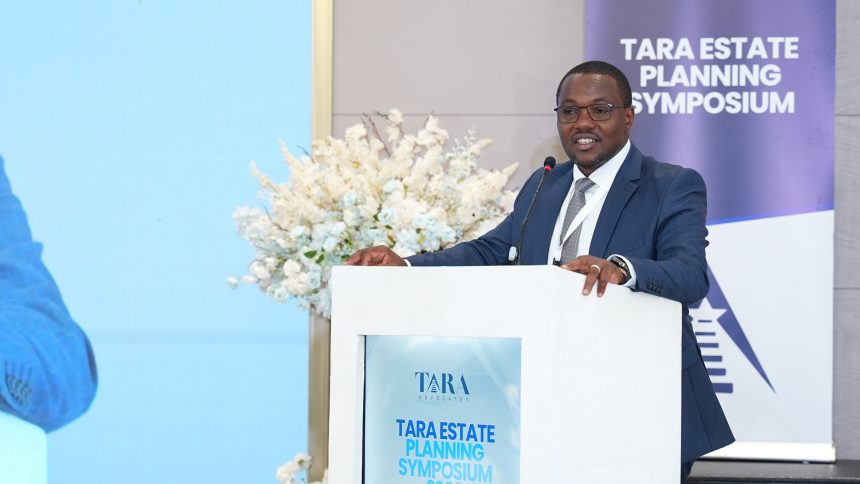
That message formed the centre piece of my remarks at the recent TARA Estate Planning Symposium in Kampala on July 16 2026 at Arirang Hotel, where stakeholders from the legal, financial and business communities gathered to launch; The Estate Planning Association (TEPA). The symposium reflected a growing recognition across Uganda and the region that estate planning is no longer simply a legal matter, it is an economic, governance and family imperative.
At ICEA LION Trust Company, which this year celebrates 40 years of helping families preserve and transfer wealth across generations, we have observed one recurring lesson: creating wealth and preserving it require two entirely different skill sets. Recently while presenting at the launch of the Tara Estate Association on July 16 2026 at Arirang Hotel in Kampala.
Building a successful business often depends on entrepreneurial instinct, personal relationships and decisive leadership. Preserving that success requires governance, systems, transparency and deliberate succession planning.

Unfortunately, many families devote decades to creating wealth but very little time preparing for what happens after the founder steps aside.
The consequences are visible throughout the region. Businesses that once employed hundreds collapse within a few years of the founder’s death. Families become embroiled in expensive legal disputes. Valuable land remains tied up in succession cases for years. Enterprises lose key customers because relationships were never transferred. Assets are divided, but the knowledge, leadership and vision that created them disappear.

These outcomes are not inevitable. They are usually the result of decisions that were postponed.
Global research consistently shows that nearly 70 percent of family wealth fails to survive the transition from the first generation to the second. By the third generation, most of what remains has disappeared.
The reasons are remarkably consistent across countries and cultures. Families often mistake assets for wealth.
Land, buildings, shares and bank accounts are important, but they represent only part of a family’s wealth. The greater value often lies in less visible assets, business relationships, institutional knowledge, governance structures, customer confidence, reputation and entrepreneurial capability.
A family business can inherit every building the founder owned yet lose much of its value if future leaders are unprepared to run it.
That is why succession planning must move beyond distributing assets. It must prepare people.
Successful family enterprises understand that continuity rests on three interconnected pillars; The first is the family itself.
Succession begins with honest conversations. Families must discuss expectations openly, define responsibilities clearly and prepare future leaders before transitions become urgent. Avoiding difficult conversations today often creates far greater conflict tomorrow.
The second pillar is values-Every enduring family possesses principles that define how decisions are made, how conflict is resolved and how success is measured. Integrity, stewardship, responsibility, service and entrepreneurship cannot simply be inherited. They must be intentionally taught and demonstrated across generations.
The third pillar is governance-Many founders successfully manage businesses through personal authority. Future generations cannot rely solely on personality.
Strong governance provides continuity regardless of who occupies leadership positions. It establishes decision-making processes, accountability, family councils, succession policies and mechanisms for resolving disagreements before they become destructive.
Governance transforms businesses from founder-dependent enterprises into enduring institutions. This distinction is becoming increasingly important across East Africa.
Many of today’s successful businesses are reaching second-generation transitions at a time of rapid technological change, expanding regional markets and growing investor expectations. Future leaders must preserve the values that built these enterprises while adapting them to entirely different economic realities.
That balance cannot be achieved through a will alone.
Estate planning is often misunderstood as a legal exercise that begins toward the end of life. In reality, it should begin much earlier.
Planning should start when entrepreneurs establish businesses, acquire significant assets, welcome children into the family or enter partnerships. It should evolve as businesses grow, investments diversify and family circumstances change.
Effective estate planning integrates legal, financial, governance and family considerations into one coherent strategy.
It is also important to recognise that succession is not solely about transferring ownership. Leadership must be transferred. knowledge must be documented. Relationships must be nurtured.
Future generations must understand not only what they inherit but why it exists and the responsibilities that accompany it.
This is where professional trustees play an increasingly important role.
Independent trustees provide continuity beyond individual family members, help preserve agreed governance structures and ensure that decisions remain aligned with the long-term interests of beneficiaries. They create confidence during periods of uncertainty and help families separate emotion from governance.
As East Africa’s economies continue to mature, succession planning should become part of mainstream business planning rather than an afterthought.
Governments have invested heavily in creating environments that encourage entrepreneurship and investment. The next challenge is ensuring that the wealth created today continues generating employment, investment and opportunity long after its founders have left the stage.
No entrepreneur builds a business simply to see it disappear within one generation. Every founder hopes to leave something that endures. Ultimately, legacy is not measured by the size of an estate.
It is measured by whether future generations remain united, whether businesses continue creating value and whether families become stronger rather than divided because of the wealth they inherit. None of us will be here a century from now.
What will remain are the institutions we build, the values we pass on and the governance systems we establish today.
That is why estate planning is not about preparing for death. It is about preparing families to thrive for general
Written by Peter Wachira
The writer is the Chief Executive Officer, ICEA LION Trust Company