For nearly 40 years, the National Resistance Movement (NRM) has led Uganda under the steady leadership of H.E. Yoweri Kaguta Tibuhaburwa Museveni. Now, the party returns to the people, seeking a renewed mandate for the presidential term 2026–2031. With the campaign slogan “PROTECTING THE GAINS,” the NRM invites Ugandans to reflect on and defend the progress made since 1986.

Since assuming power, the NRM has led a liberation struggle focused on transforming key sectors including education, health, transport, science and technology, socio-economic development, and peacebuilding. The party believes these gains are substantial, hard-earned, and worth safeguarding for future generations.
Below is a breakdown of some of the major achievements the NRM government cites as “gains to protect.”
GAINS TO PROTECT
Uganda had a population of 15.47 million in 1986 when the NRM took overpower. The slow population growth at the time was largely due to high infant mortality rates caused by six killer diseases (polio, tetanus, tuberculosis, whooping cough, etc.).

To combat this, the NRM government introduced national immunization programs that significantly reduced childhood mortality. As a result, the population grew rapidly:
- 1995: 20.67 million
- 2010: 32.39 million
- 2020: 44.46 million
- 2025 (estimated): 51.4 million
Health Sector Decentralization
Government policy emphasized bringing health services closer to the people by establishing:
- A Health Centre II in every parish
- A Health Centre III in every sub-county
- A Health Centre IV in every constituency
- At least one hospital in every district
This decentralization has played a critical role in reducing mortality rates and improving overall healthcare access.
Education Expansion
In 1986, Uganda had only one public university—Makerere University, producing just 5,400 graduates annually. The NRM government decentralized higher education by establishing public universities in every sub-region, including:
- Kabale University (Kigezi)
- Mbarara University of Science and Technology – MUST (Ankole)
- Busoga University (Busoga)
- Mountains of the Moon University (Rwenzori)
- Busitema University (Bukedi & Bugisu)
- Soroti University (Teso)
- Muni University (West Nile)
- Gulu University (Northern Uganda)
These are supported by numerous private universities and tertiary institutions, now producing over 700,000 graduates annually, a dramatic increase from 1986.
The introduction of Universal Primary Education (UPE) and Universal Secondary Education (USE) reduced the school dropout rate to 8.03%. Between 1986 and 2004:
- Primary school enrollment rose from 2,203,824 to 7,377,292
- Secondary school enrollment increased from 123,479 to 697,507
Clear government policies to establish a government primary school in every parish and a secondary school in every sub-county have brought education services closer to communities across the country.
If it were not for UPE and USE, Uganda would not have many of the educated youth it has today. The opposition, which often focuses on youth unemployment, ignores who enabled millions to access affordable education in the first place.
Peace and Refugee Hosting
In 1986, an estimated 500,000 Ugandans had sought refuge in neighboring countries due to political instability caused by opportunistic leadership. The NRM government restored peace and security.
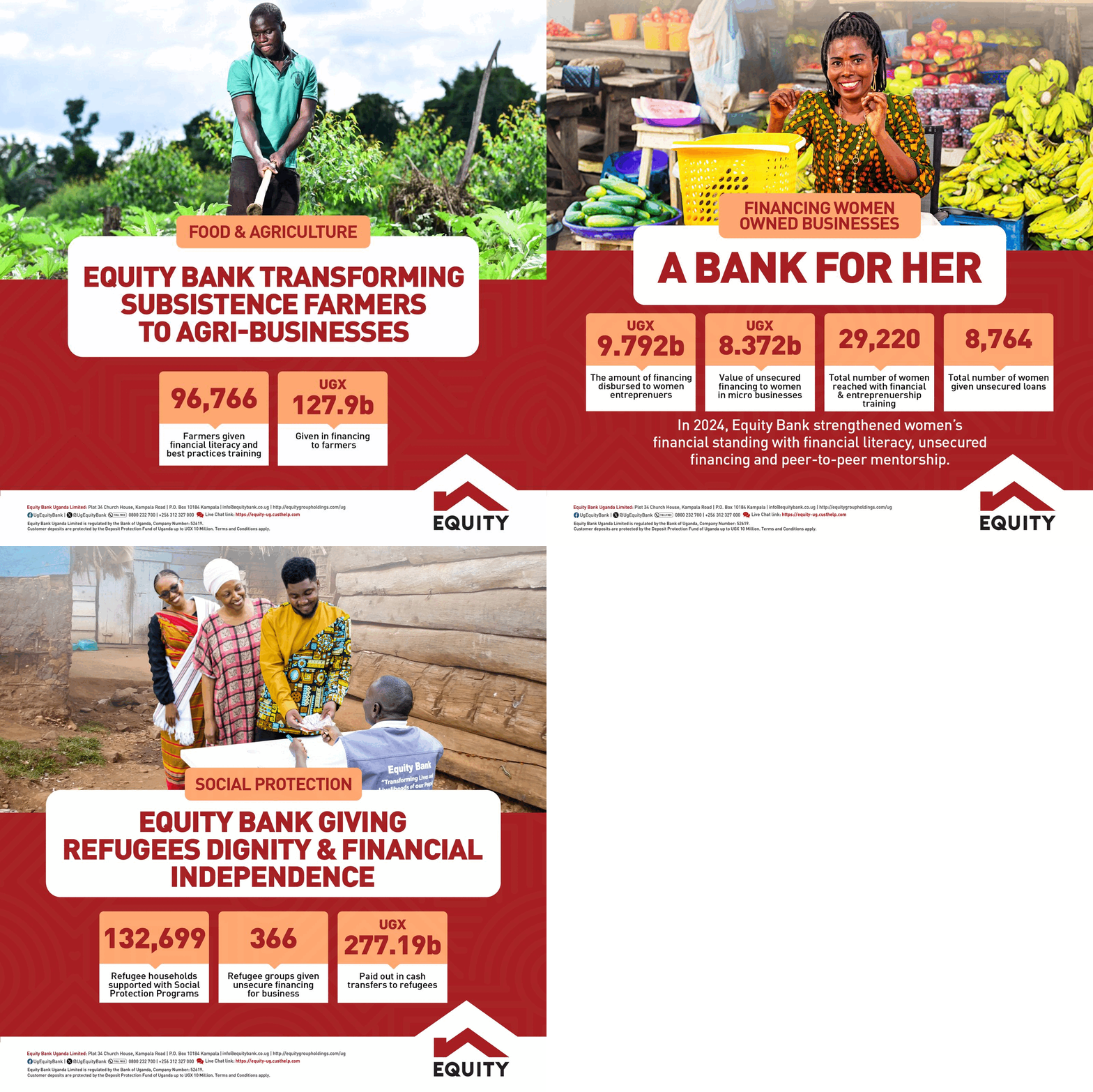
Today, Uganda is the top refugee-hosting country in Africa, with over 2 million refugees, highlighting the country’s stability and hospitality.
Road Infrastructure Development
In 1986, Uganda had only 1,900 kilometers of paved roads. Under NRM leadership, this has expanded to over 6,199 kilometers by 2025. This road expansion has boosted tourism and improved the transport of goods and services.
Feeder roads have also been extended to nearly all villages, enhancing access to markets for agricultural produce.
Electricity and Industrialization
In 1986, Uganda generated approximately 60 megawatts of electricity. As of 2025, this capacity has grown to 2,048.1 megawatts, thanks to significant investments in hydropower.
This increase has stimulated rapid industrialization and improved electricity supply for commercial, domestic, and manufacturing use.
Access to Clean Water
In 1986, fewer than 10% of Ugandans had access to clean water. Today, over 75% of the population has access to safe drinking water. This has drastically reduced waterborne diseases and reduced the healthcare burden on families.
Economic Growth
Uganda’s GDP has grown steadily under NRM leadership:
- 1986: $3.923 billion
- 2000: $6.193 billion
- 2010: $20.67 billion
- 2020: $37.6 billion
- 2025 (projected): $56.69 billion
This growth is attributed to NRM’s strategic focus on increasing production, fighting poverty, and enabling a business-friendly environment.
When the NRM took power in 1986, Uganda was a nation in crisis—with a collapsed economy and dysfunctional government systems. Through visionary leadership, these systems were revived, and Uganda began a journey of peace, stability, and sustained economic growth.
Today, with a stable economy, improved healthcare and education, robust infrastructure, and peace across the country, it is clear that the NRM has made substantial gains.
As we approach 2026, Ugandans must come together to protect and build on these achievements.
Vote H.E. Yoweri Kaguta Museveni in 2026
A visionary leader with a proven track record.
“PROTECTING THE GAINS” is not just a slogan, it is a responsibility we all share.
Written by Tukwatanise Musa, ARDC – Rwampara District | NRM General Secretary – Sheema District Youth League | PLU Activist.