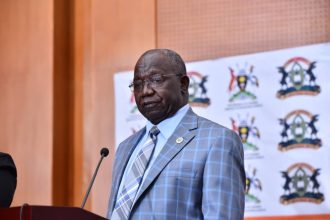
This was during its EABC 23rd Annual General Meeting (AGM) on December 13, 2024, at the prestigious Mount Meru Hotel in Arusha, Tanzania.
The event, a landmark moment for regional business collaboration, attracted high-level stakeholders from across the East African Community (EAC), who deliberated on achievements and set the stage for deeper integration and economic development.
The chief guest for the occasion was Mr. Frank Mbando, the assistant regional administrative secretary, representing Hon. Paul Makonda, the regional commissioner of Arusha.
Mbando praised the EABC for fostering East Africa’s economic growth. He invited business leaders to invest in Arusha, particularly in the edible oil and textile industries, while urging the region to prepare for opportunities tied to the Africa Cup of Nations (AFCON 2027), which Tanzania, Kenya, and Uganda will co-host.

During the AGM, Mr. John Lual Akol Akol, representing the South Sudan National Chamber of Commerce, Industry, and Agriculture, was elected Chairperson for the 2024–2026 term. In his acceptance speech, Mr. Akol expressed gratitude to the outgoing Executive Committee for their visionary leadership and pledged to steer the council toward a unified and thriving East African business ecosystem.
“EABC must remain the voice of the private sector, championing a borderless business environment that unlocks the region’s economic potential,” said Mr. Akol.

Governance Reforms and Elections
The AGM approved key amendments to the EABC Memorandum and Articles of Association (MEMARTs), including the formation of a Governing Council to enhance accountability and decision-making. Elections were also held to appoint members to the Governing Council and Executive Committee for the 2024–2026 term, ensuring representation from all six EAC member states.
Uganda’s Representatives:
Uganda secured influential representation with the election of four business leaders:
- Simon Kaheru, Vice Chairperson, representing Uganda Manufacturers Association (UMA).
- Oscar Kamukama, Steel and Tube Industries.
- Kenneth Ayebare, Private Sector Foundation Uganda (PSFU).
- Bruce Mpamizo, Movit Products Limited.
“These appointments demonstrate Uganda’s commitment to regional integration and private sector development,” Mr. Njau remarked, emphasising the importance of such leadership in driving cross-border trade and reducing barriers to investment.
Representatives from Other EAC States:
Burundi:
- Hon. Olivier Suguru – Vice Chairperson, Burundi Federal Chamber of Commerce and Industry (CFCIB).
- Mr. Boaz Nimpe – Burundi Bankers Association (ABEF).
- Mr. Laurent Nsenda Bukassa – BRARUDI.
- Ms. Linda Kaneza – SAVONOR.
Kenya:
- Mr. Jas Bedi – Vice Chairperson, Chairman of the Kenya Private Sector Alliance (KEPSA).
- Mr. Rajan Shah – Former Chairperson, Kenya Association of Manufacturers (KAM) and CEO, Capwell Industries.
- Mr. Muhoho Kenyatta – Executive Chairman & CEO, Brookside Dairy Ltd.
- Mr. Clifford Machoka – Senior Director, Public Affairs East & Central Africa, Coca-Cola.
Rwanda:
- Mr. Dennis Karera – Vice Chairperson, Private Sector Federation Rwanda (PSF-R).
- Ms. Linda Kalimba Mulenga – Trinity Lawyers.
- Mr. Emmanuel Nkusi – Bank of Kigali.
- Mr. Emmanuel Butare – MRB Attorneys.
South Sudan:
- Mr. Kennedy Lodiong Kenyi – Association of South Sudan Manufacturers.
- Mr. Mou Ambrose Thiik – Trinity Group.
- Mr. Osama M. Bilal – Nile Commercial Bank PLC.
Tanzania:
- Ms. Angelina Ngalula – Vice Chairperson, Tanzania Private Sector Foundation (TPSF).
- Mr. Paul Makanza – Vice Chairperson, Tanzania Cigarette Public Limited Company.
- Mr. Ashish Mistry – ALAF Group of Companies.
- Mr. Satbir Singh – Hanspaul Group of Companies.
Achievements and Outlook
Reflecting on the 2023/24 period, the EABC highlighted key achievements, including:
- Advocacy for the reduction of non-tariff barriers (NTBs).
- Promotion of regional trade facilitation measures.
- Strengthened inclusion of small and medium enterprises (SMEs) in regional economic activities.
According to Mr. Adrian Njau, Secretary to the EABC Board, “The AGM has reaffirmed the critical role of the private sector in driving regional economic integration. It is also a platform for reflecting on progress and charting the way forward to address challenges hindering cross-border trade and investment.”
“The AGM has provided a roadmap to strengthen private sector collaboration and align efforts with the EAC integration agenda. This is a pivotal step towards realising a truly borderless and prosperous East Africa,” said Mr. Njau.
The 23rd AGM concluded with a call for renewed collaboration among East Africa’s business community. With new leadership in place, the council is poised to intensify its efforts in addressing trade barriers, fostering innovation, and creating an enabling environment for businesses across the region.