

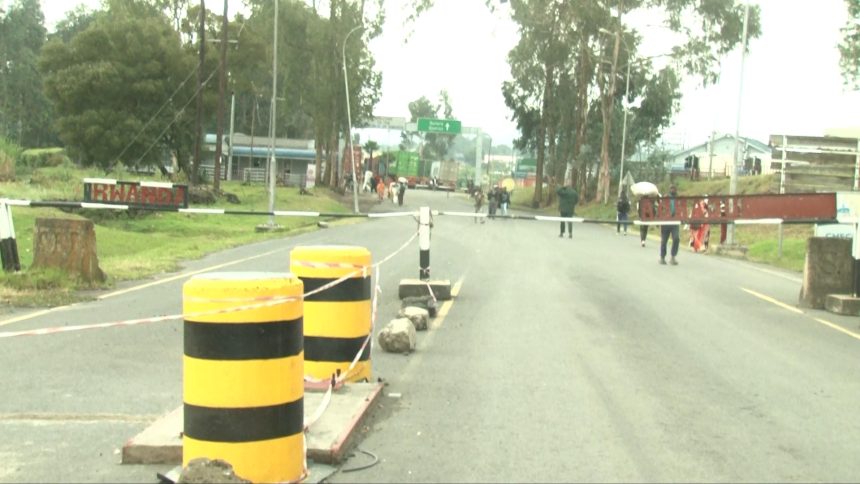
The business community at the Uganda-Rwanda border in Cyanika is grappling with the consequences of sharp currency fluctuations, as the Rwandan Franc continues to weaken against the Ugandan Shilling.
Since 2023, the Rwandan Franc has steadily depreciated, falling from an exchange rate of over 3.0 Ugandan Shillings to approximately 2.48 shillings as of August 13, 2025—a decline of nearly 25–30% over the long term. In just the past six months, the rate dropped from around 2.656 shillings, marking a further depreciation of 7.14%.
This weakening reflects broader economic imbalances, such as inflation disparities, trade deficits, and differing monetary policies between the two countries. Short-term volatility has also been linked to market sentiment and external geopolitical factors, all of which have negatively impacted cross-border trade.
Local money changers at the Cyanika border, including Bazamenya Charles and Ntegeye William, report a sharp decline in business. They say the falling value of the Rwandan Franc has discouraged Rwandan traders from purchasing goods in Uganda, as the unfavorable exchange rate makes Ugandan products too expensive.
“Our business has totally declined,” said one money changer. “The Ugandan Shilling is too strong compared to the Rwandan Franc. Rwandan traders are no longer interested in importing goods from Uganda because it’s no longer profitable.”

Tibarikure Charles, LC1 Chairperson of Gahuru Cell in Rukoro Ward, Chanika Town Council, echoed these sentiments, noting that international trade once significantly improved livelihoods in the region. “We used to benefit a lot from cross-border trade, but that is no longer the case. The economic impact is visible in people’s lives,” Tibarikure said.
Meanwhile, Erasmus Sanyu, Mayor of Chanika Town Council, attributed part of the current crisis to the ongoing conflict in the Democratic Republic of Congo (DRC). He argued that the instability in the region has effectively isolated Rwanda as Uganda’s only consumer along this corridor. “With the DRC conflict disrupting trade routes, Rwanda has become Uganda’s only viable market here. We urge the Ugandan government to step in and stabilize trade,” Sanyu said.

Stakeholders now call for coordinated efforts between Uganda and Rwanda, including potential tax reforms and regional trade agreements, to revive cross-border commerce and restore livelihoods dependent on trade at the Cyanika border.
Cyanika border is located in the southwestern part of Uganda, near Kisoro District, and in the northeastern part of Rwanda, close to Musanze, also known as Ruhengeri. It is a vital crossing point for trade and tourism between the two countries.
To enhance efficiency at border crossings, a Migration Information and Data Analysis System (MIDAS) has been implemented. This border management information system helps collect, process, store, and analyze data on travelers, improving the management of cross-border movements.
Institutions such as the Uganda National Immigration Training Academy in Nakasongola District have also been established to support efficient border operations. The Immigration and Border Management (IBM) division has trained officials in document inspection, immigration intelligence, and the use of MIDAS.
The Uganda Revenue Authority (URA) manages the border from the Ugandan side, while the Rwanda Revenue Authority (RRA) oversees the Rwandan side. The two authorities collaborate to facilitate smoother travel, especially for tourists.
To promote tourism and easier travel, an East African Tourist Visa was introduced. This visa is valid for 90 days and allows multiple entries across East African Community (EAC) member states. It does not permit employment and cannot be extended once expired.
Travelers crossing the Cyanika border must present valid documents such as a passport, national ID, student ID, or a temporary travel document for East African citizens without passports. The crossing process involves presenting these documents, passport stamping, and other customs procedures.
Cyanika is also a gateway to major tourist attractions, including Mgahinga Gorilla National Park in Uganda and Volcanoes National Park in Rwanda. It is approximately a 9–10 hour drive from Kampala and 4–5 hours from Kigali.
Common modes of transport across the border include buses, special hire vehicles, and motorcycles. Bus companies like Jaguar Executive and Trinity Express offer regular cross-border routes.
Before crossing, travelers are advised to exchange currency—either to Ugandan Shillings or Rwandan Francs—to ensure smooth transactions on the other side.
















Expert service perfection, demonstrates true professionalism. Professional excellence found. Professional appreciation.