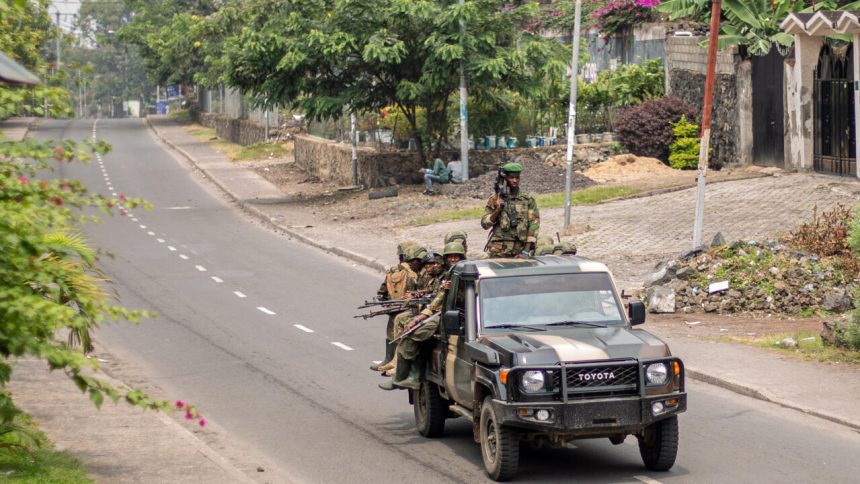
Nairobi – Despite growing international pressure for a ceasefire, Rwandan-backed M23 rebels continued their advance in eastern Democratic Republic of Congo on Wednesday, seizing territory and prompting Congo to announce plans for a military response. The rebels’ actions come as East African leaders convened an emergency summit to address the escalating crisis.
Congo President Felix Tshisekedi, while expressing a preference for diplomacy, declared on Wednesday night that he would pursue a military option. He warned that the “presence of thousands of Rwandan soldiers on our soil… (is leading) to an escalation with unpredictable consequences.”
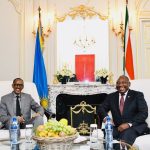
The East African Community (EAC), comprised of eight nations including Congo and Rwanda, held an emergency summit, calling for an immediate ceasefire and urging Congo to engage in negotiations with M23. The UN Security Council echoed these calls earlier this week. Notably, President Tshisekedi did not attend the EAC summit, while Rwandan President Paul Kagame did.
Following their capture of Goma, a city of 2 million and the capital of North Kivu province, on Monday, M23 rebels advanced south, seemingly aiming to expand their control. They marched along Lake Kivu’s western shore, approaching Kavumu, the location of Bukavu’s airport.
This recent escalation marks the most serious flare-up in the decades-long conflict in eastern Congo since 2012. The conflict’s roots lie in the spillover from the 1994 Rwandan genocide and the ongoing struggle for control of Congo’s vast mineral wealth.

In Goma, a critical hub for displaced persons, aid organizations, UN peacekeepers, and Congolese forces, the rebels solidified their control and patrolled the border with Rwanda.
Despite a flurry of diplomatic efforts, including a statement from the United States expressing deep concern over Goma’s fall and Germany’s cancellation of aid talks with Rwanda, the situation on the ground remained unchanged.

Mercenaries Exit via Rwanda
Sporadic gunfire was heard on Wednesday in Goma’s outskirts. Bodies from Monday’s fighting littered the streets, hospitals were overwhelmed, and UN peacekeepers remained in their bases.
At the Goma-Gisenyi border crossing, Reuters reporters witnessed dozens of Romanian mercenaries, hired by Congo to bolster its defenses, crossing into Rwanda. One mercenary confirmed they were beginning their journey home. These mercenaries, reportedly numbering over 280, underwent checks by Rwandan police and boarded buses to Kigali.
M23 represents the latest in a series of ethnic Tutsi-led, Rwandan-backed insurgencies in Congo since the 1994 genocide. Rwanda maintains that some perpetrators of the genocide, in which extremist Hutus killed Tutsis and moderate Hutus, fled to Congo, posing a threat to both Congolese Tutsis and Rwanda. Congo refutes these claims, accusing Rwanda of exploiting proxy militias to plunder its mineral resources.
In a Wednesday interview with Reuters, Rwanda’s foreign minister called for a nationwide ceasefire in eastern Congo and urged Kinshasa to negotiate with the rebels.
East African leaders announced plans for a joint summit with southern African leaders to address the crisis. Tshisekedi visited neighboring Angola, which has played a mediating role in the past, according to Angola’s presidency.