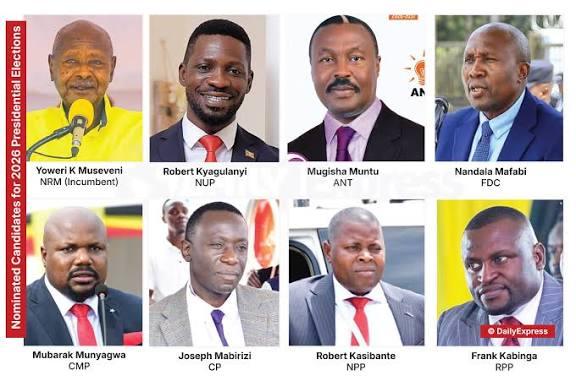
With eight contenders cleared by the Electoral Commission, Uganda is officially in election mode. Each candidate brings unique political weight, different party structures, and contrasting visions for the country. But as campaigns begin, their strengths and weaknesses could decide who emerges as a serious contender and who remains on the periphery.
1. Yoweri Kaguta Museveni — National Resistance Movement (NRM)
Strengths: Museveni commands an unrivaled political machinery built over nearly four decades in power. The NRM’s nationwide structures, financial muscle, and record in maintaining stability give him a strong edge. His messaging will center on economic progress, regional security, and Uganda’s lower middle-income status.
Weaknesses: After almost 40 years in office, fatigue and calls for change are strong, especially among youth. Rising cost of living, unemployment, and perceptions of over-staying could erode support, particularly in urban areas.
2. Robert Kyagulanyi Ssentamu (Bobi Wine) — National Unity Platform (NUP)
Strengths: Charismatic and youthful, Kyagulanyi remains the face of opposition politics. He connects strongly with urban voters, unemployed youth, and those craving generational change. His large grassroots following in central Uganda makes him Museveni’s main challenger.
Weaknesses: Limited structures outside urban centers, especially in rural Uganda. Critics say his party is short on policy depth, and heavy state pressure on NUP’s activities may constrain his campaign.
3. Nathan Nandala Mafabi — Forum for Democratic Change (FDC)

Strengths: An experienced legislator with deep grassroots support in eastern Uganda. Mafabi is respected for his parliamentary record, toughness in debates, and financial acumen. The FDC brand, though weakened, still resonates with older opposition supporters.
Weaknesses: FDC has suffered internal divisions and defections, reducing its national visibility. Mafabi’s appeal beyond eastern Uganda is uncertain, and he risks being overshadowed by Bobi Wine’s mass following.
4. Mugisha Muntu — Alliance for National Transformation (ANT)
Strengths: Muntu is respected for integrity, discipline, and principled leadership. His calm and moderate style appeals to Ugandans weary of confrontational politics. ANT, though small, attracts intellectuals and civil society.
Weaknesses: ANT lacks a strong grassroots base, making nationwide mobilization difficult. His non-confrontational approach is seen by some as too soft in Uganda’s heated political climate.
5. Mubarak Munyagwa — Common Man’s Party (CMP)
Strengths: Popularly known for his humor and bold style, Munyagwa appeals to ordinary Ugandans who feel sidelined by elite politics. His populist rhetoric gives him visibility in Kampala.
Weaknesses: His party is new and largely untested. Outside the capital, his influence is minimal, and his unpredictability could weaken his credibility as a serious presidential contender.
6. Frank Bulira Kabinga — Revolutionary People’s Party (RPP)
Strengths: As a new face, Kabinga brings freshness to the field and appeals to voters seeking alternatives beyond the usual heavyweights.
Weaknesses: RPP has almost no established structures, and Kabinga’s national profile is low. His chances of breaking into the top tier of the race are slim.
7. Robert Kasibante — National Peasants Party (NPP)
Strengths: Focuses on rural Ugandans, a constituency that forms the bulk of the electorate. His messaging around agriculture and peasant empowerment resonates with some grassroots communities.
Weaknesses: Very limited resources, weak organization, and lack of visibility. Nationally, he remains a fringe candidate.
8. Joseph Mabirizi — Conservative Party (CP)
Strengths: A familiar face in Uganda’s politics, Mabirizi campaigns on morality, constitutional reform, and conservatism. His persistence has earned him recognition among small but loyal supporters.
Weaknesses: Has contested before with little impact, and his support base is thin. Many view him more as a perennial candidate than a potential winner.
OUTLOOK
While the eight candidates present diversity, the real contest appears to be between Museveni’s NRM and Kyagulanyi’s NUP, with Mafabi and Muntu playing important secondary roles. The absence of women and independent contenders makes this year’s race unique. Over the next three months, strengths and weaknesses will be tested on the campaign trail as Ugandans prepare to choose their next leader.