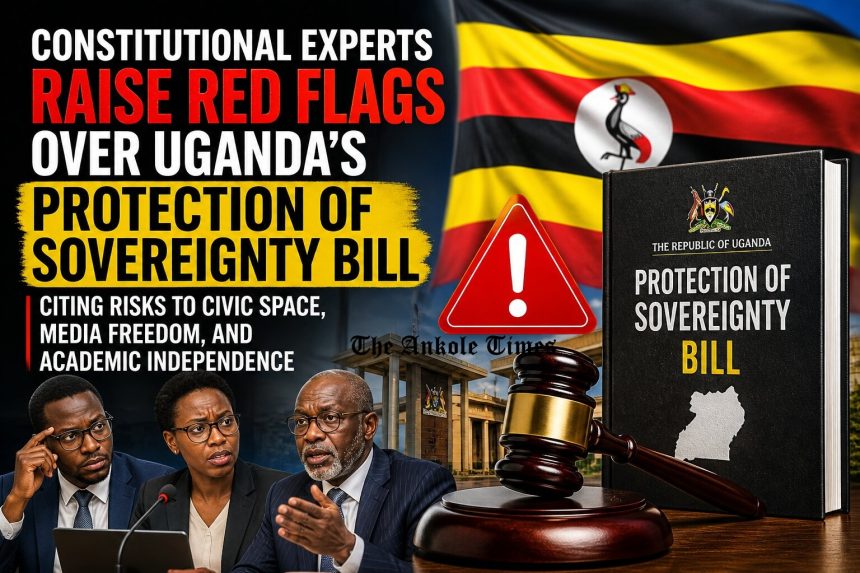
A new legal and constitutional critique has raised serious concerns over Uganda’s amended Protection of Sovereignty Bill, 2026, warning that despite recent revisions, the proposed law still contains provisions that could undermine constitutional freedoms and democratic governance.
The analysis, authored by legal scholar Isaac Christopher Lubogo, describes the Bill as a second legislative attempt to regulate individuals and organisations alleged to act in foreign interests within Uganda.
While acknowledging that the amended version corrects some of the most controversial elements of its predecessor, the critique argues that the Bill remains constitutionally vulnerable and potentially open to challenge before the Constitutional Court.
The critique recognises several positive amendments, including the removal of provisions that previously extended the definition of a “foreigner” to Ugandan citizens abroad, and the scrapping of ministerial powers that could arbitrarily label individuals as foreigners without judicial oversight. It also highlights the introduction of intent-based criminal standards such as “knowingly” and “intentionally,” which align more closely with established principles of criminal responsibility. Additionally, new safeguards requiring court orders before inspections of premises are described as a step forward in protecting constitutional rights against arbitrary searches. Further improvements include clearer timelines for administrative decisions on registration and exemptions for institutions such as banks, academic bodies, faith-based organisations, and certain service providers.
Despite these adjustments, the critique warns that major structural and legal problems persist. At the heart of the concern is what the analysis describes as overly broad and vague definitions of “agent of a foreigner,” “political activities,” and “disruptive activities.” According to the report, these definitions could potentially capture legitimate activities such as journalism, academic research, civil society advocacy, and human rights work—particularly where foreign funding is involved. The Bill is also said to risk criminalising legitimate political expression, with provisions that are so broad they could chill free speech protected under Article 29 of the Constitution.

One of the strongest criticisms targets the Bill’s penalty regime, which prescribes up to 20 years’ imprisonment for certain offences. The critique argues that such severe penalties are disproportionate, especially where the offences relate to administrative non-compliance or civic engagement involving foreign funding. It further warns that this could conflict with constitutional protections against cruel and inhuman treatment and fail the proportionality test established in Uganda’s constitutional jurisprudence.
The analysis also raises concern over what it describes as excessive concentration of power in the executive, noting that significant regulatory and enforcement authority remains vested in the Minister, including control over registration, revocation of certificates, and definition of key terms through ministerial regulations. According to the critique, this undermines the separation of powers and weakens judicial and parliamentary oversight.

Beyond legal technicalities, the report warns that the Bill could have far-reaching implications for civic space in Uganda. It argues that investigative journalism, human rights advocacy, and academic collaboration may all be placed at risk if interpreted through an expansive security lens. It also highlights the absence of an independent oversight body and lack of whistleblower protections as structural weaknesses that could discourage transparency and accountability.
The critique concludes that while the amended Bill reflects progress, it still requires substantial reform to align with constitutional standards and Uganda’s international human rights obligations. It recommends a narrower legislative model focused specifically on foreign government-directed political interference, stronger safeguards for civic and academic activity, tiered penalties, and the creation of an independent regulatory tribunal. Without such reforms, the analysis warns, the Bill risks judicial invalidation and international criticism, potentially undermining both its legitimacy and its stated goal of protecting national sovereignty.
The critique was prepared by Isaac Christopher Lubogo of Suigeneris Consultancy, Kampala.