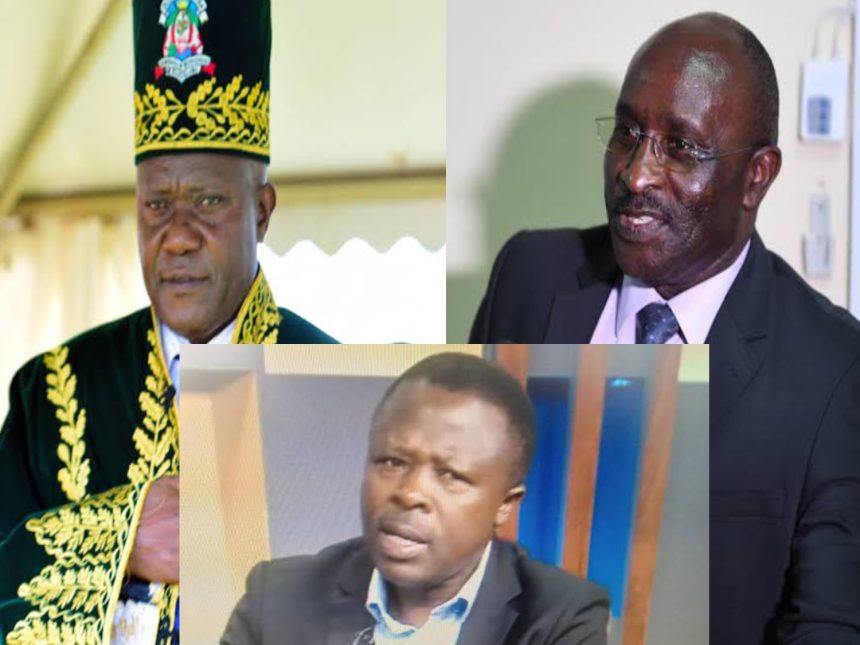
I recently came across a statement purportedly authored by Hon. Ambassador Simon Mulongo regarding His Highness the Umukuka III, Jude Mike Mudoma, and the corrigenda issued by the Minister of Gender, Hon. Betty Amongi.
As the official spokesperson of the Bugisu Cultural Institution, I find it necessary to respond to the misrepresentations and distortions contained in that statement. These inaccuracies not only threaten to mislead the public but also undermine the very unity we are striving to build among the Bamasaaba people.
Hon. Mulongo’s critique of the Minister’s corrigenda fails to acknowledge the fact that the Minister of Gender is legally empowered to make such administrative corrections in line with the Cultural Leaders Act. Her actions were not arbitrary, they were grounded firmly within Uganda’s legal framework.
If one wishes to contest those actions, they must cite specific legal provisions, not personal opinion. Without such references, your objections appear more political than legal, more divisive than constructive.
Your own record, Hon. Mulongo, as captured in the Hansard of Parliament, reflects attempts to fragment our community by promoting the formation of a fictitious tribe called “Babukusu”—a concept which has failed to establish any ethnic, geographical, or legal footing. That effort to redraw the boundaries of our identity has only served to confuse and divide our people.

Furthermore, your portrayal of His Highness the Umukuka III as someone seeking personal gain is unfounded and disrespectful. The Umukuka is not a lawmaker or law enforcer, and he has not claimed powers he doesn’t possess. Instead, he has chosen peace, legality, and community upliftment. He has petitioned the courts to resolve leadership disputes rather than allowing chaos to reign. He has lobbied for educational scholarships for our youth, championed support for landslide victims in Bunambutye (with over UGX 100 million in relief items delivered), and worked with government and development partners to benefit our community.
To accuse such a man of self-aggrandizement is not only inaccurate, it is unjust. If this is your definition of selfishness, then perhaps it is your definition that needs reevaluation.

You also attempt to discredit the name “Bugisu,” yet this name is rooted in both legal and historical record. It was referenced as early as 1900 by British scholar Rascoe and was included in the 1962 Constitution as one of Uganda’s recognized tribal regions. If you found the term so problematic, why did you not contest it during the 1994 Constituent Assembly, where you had the platform and opportunity to do so? Instead, you coined “Bukusu” in an apparent effort to counter “Bugisu.” Who then is sowing division?
Your critique of the corrigenda ignores the broader national context. This wasn’t an isolated act targeting Bugisu—it was a uniform policy applied across Uganda’s cultural institutions. When Inzu Ya Masaba was formed around 2009, there was no legal framework for cultural institutions. The enactment of the Cultural Leaders Act in 2011 changed that, and like all institutions, Inzu Ya Masaba was required to align with the law. We must remember that no institution is above the Constitution of Uganda. Article 2 is clear on this.
The cultural leadership conflict that began around 2020 was met with restraint and wisdom by Umukuka Jude Mike Mudoma, who chose to follow lawful procedures instead of engaging in confrontation. When the Hon. Minister of Gender eventually intervened, she asked Umukuka I (Emeritus) to mediate between the factions. A consensus was reached at a meeting in Maluku District Hall, where clan leaders and other stakeholders affirmed Jude Mike Mudoma as the legitimate cultural leader. This outcome was later communicated to the Chief Justice and other national stakeholders.
Your narrative conveniently omits this important chapter in our recent history. Is this the kind of leader you call divisive? One who respected the courts, upheld the law, and embraced dialogue?
Moreover, it is deeply troubling that you ignore the root of the cultural strife—which is traceable to a group we now refer to as the WWWWW: Walimbwa, Washaki, Wamimbi, Wabuyi, and Wedaira. These individuals, after being relieved of their roles by the Umukuka III, began subversive activities against the institution. Some are now facing criminal investigations. Instead of defending them, we urge you to let justice take its course.
Under the leadership of Umukuka Jude Mike Mudoma, the Bugisu Cultural Institution has made tangible achievements. These include: securing university scholarships; providing disaster relief in Bunambutye; renovating the annex building (UGX 70 million); lobbying UGX 8 billion for the cultural center; training clan chairpersons on HIV prevention; successfully launching the Imbalu cultural ceremony; hosting foreign dignitaries and cultural leaders; and having Imbalu registered with UNESCO. Plans are also underway for the construction of a Bugisu Museum.
These accomplishments reflect a vision grounded in service, tradition, and lawful leadership—not self-interest.
Lastly, we must remember that while individual cultural leaders may change over time, the institution of Bukuka is designed to endure. Nowhere has Umukuka III declared himself a leader for life. The claim that he seeks a permanent reign is both baseless and inflammatory. Our institution is built on the rule of law, and our leaders are bound by it—just as all Ugandans are.
I have, on occasion, asked Engineer Sakwa to cite the legal basis upon which the so-called Inzu Ya Masaba constitution was enacted. I am still waiting for a response. In Uganda, lawmaking is the exclusive preserve of Parliament under Article 79 of the Constitution and, to some extent, local governments under Section 38 of the Local Government Act. Elders of Inzu Ya Masaba exercised powers they do not legally possess in creating their own constitution. We already have enough statutes, and customary law, by its very nature, cannot be codified entirely.
I urge you, Hon. Mulongo, to abandon this campaign of distortion. Retract your misleading statements. Apologize to His Highness the Umukuka III and to the Bamasaaba people for the disservice your words have done to our unity. Let us, instead, work together to preserve our cultural heritage, uphold our legal obligations, and build a future of peace, truth, and dignity for all Bamasaaba.
Steven Masiga
Spokesperson, Bugisu Cultural Institution
Tel: 0782 231 577