Kampala, Uganda – October 6, 2025:
The Electoral Commission (EC) has clarified that presidential candidates in the 2026 general elections are allowed to raise and solicit funds for their campaigns — but only within the boundaries set by law.
Speaking to the media on Monday, Julius Mucunguzi, the Electoral Commission spokesperson, said the Presidential Elections Act permits candidates or their agents to fundraise as long as they do not receive money from unlawful sources.
“The Presidential Elections Act allows any presidential candidate or their agent to raise and solicit funds for campaign purposes, as long as this is done in accordance with the law,” Mucunguzi said.
He explained that the law strictly prohibits foreign governments, foreign institutions, and individuals seeking to overthrow the government from contributing to any candidate’s campaign.

“A candidate is not allowed to raise funds from a foreign government or foreign body, or from any person who has declared an intention to overthrow the sitting government,” he emphasized.
According to Mucunguzi, all presidential candidates are required to keep records of all the assistance they receive and to submit a report to the Electoral Commission within 30 days after the election detailing all sources of their campaign financing.

“Failure to declare campaign funding or receiving money from outlawed sources is an offense punishable by up to five years in prison and a fine of 120 currency points,” he noted.
(A currency point in Uganda equals 20,000 shillings.)
Candidates Turn to Public Fundraising
The EC clarification comes at a time when several candidates have gone public about their financial challenges.
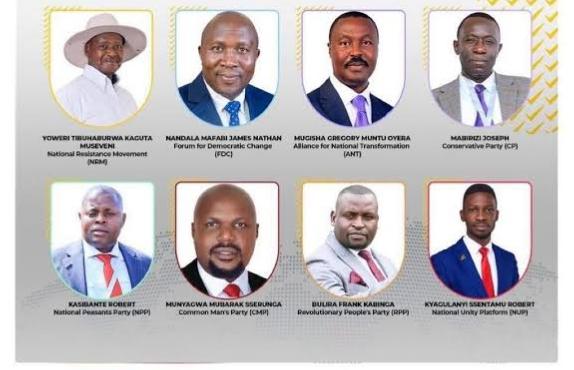
Maj. Gen. (Rtd) Mugisha Muntu, the presidential flagbearer for the Alliance for National Transformation (ANT), has openly resorted to street-level fundraising to support his campaign. He has been seen engaging supporters in Kampala and other districts, asking citizens to contribute small amounts toward his presidential bid.
“We want Ugandans to fund their own politics,” Muntu said recently. “If citizens contribute to our campaign, we shall remain accountable to them — not to shadowy donors.”
Muntu also revealed that the Electoral Commission does not give financial support to candidates, apart from providing official escorts and security vehicles.
“The EC doesn’t fund us. They only provide police escorts and security. Everything else, including fuel, transport, and accommodation, comes from the candidates themselves,” he said.
Munyagwa’s Common Man’s Party Faces Funding Struggles
Another candidate, Mubarak Munyagwa, of the newly formed Common Man’s Party, has also admitted facing financial constraints in mobilizing across the country.
“We are running on empty,” Munyagwa said during a rally in Jinja last week. “But our strength is in the people — not in the pockets of a few foreign funders.”
His party has since launched small community fundraising drives and online donation calls, appealing to supporters for direct contributions to sustain the campaign.
Bobi Wine Under Spotlight Over Foreign Funding Claims
Meanwhile, National Unity Platform (NUP) candidate Robert Kyagulanyi Ssentamu, popularly known as Bobi Wine, has once again come under government scrutiny over alleged foreign funding.
State officials have in the past accused him of receiving support from what they call “foreign elements” opposed to the government. However, no official evidence has been made public, and NUP has consistently denied the accusations, calling them politically motivated.
“All our support comes from Ugandans at home and abroad who believe in change,” Bobi Wine said in a recent interview. “We operate within the law, and we shall declare every source of support to the Electoral Commission.”
EC Urges Transparency
Mucunguzi reiterated that the Commission is monitoring compliance closely and that any violation of funding laws will attract penalties.
“The law is clear. Every candidate must declare the assistance they receive. The Commission will not hesitate to act where violations are proven,” he warned.
He also reminded the public that campaign financing transparency is essential for democracy.
“Campaigns should be financed openly and accountably. Citizens deserve to know who is funding their leaders,” Mucunguzi added.