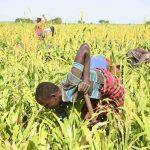
Mahyoro Town Council, Kitagwenda – A 25-year-old mother of three, Juliet Masika, was tragically killed by a stray elephant on Friday night while guarding her maize garden in Zambia Cell, Kanyabikyere Ward, Mahyoro Town Council, Kitagwenda District.
Masika’s death has reignited urgent calls from community leaders and residents for the expedited completion of a long-promised 14-kilometre electric fence intended to protect villages from wildlife incursion.
“It is a very painful loss. Masika had gone to protect her crops, only for her life to be taken by the very animals she sought to fend off,” said Ashabahebwa Silvest, LC1 Vice Chairperson.
Masika is the fifth person reportedly killed by wild animals in Mahyoro within the past two and a half years. Local leaders say the situation has reached a crisis point.
John Vincent Bimbona, Chairperson of Mahyoro Town Council, visited the scene and strongly condemned the continued loss of life due to unresolved human-wildlife conflict.

“The government launched the fencing project last year, but progress has been too slow,” he said. “We need the Uganda Wildlife Authority (UWA) to act swiftly before more lives are lost.”
In September 2023, the government commissioned a UGX 1.5 billion electric fence project to protect Mahyoro communities from elephants, hippopotamuses, and other wildlife originating from nearby conservation areas. However, residents say the project has stalled, leaving them vulnerable.

“Our people live in constant fear,” Bimbona added. “Crops are destroyed and lives are threatened almost weekly. The electric fence is not a luxury, it is a necessity.”
With tensions rising, the community is now calling on both the Uganda Wildlife Authority and the Ministry of Tourism, Wildlife and Antiquities to prioritise and fast-track completion of the fencing project. Local leaders argue that this is the only sustainable solution to the ongoing human-wildlife conflict that has plagued the region for years.
As Kitagwenda mourns another life lost, frustration is mounting over the slow response to a problem that continues to cost lives, livelihoods, and peace of mind.