Pader, Uganda – The Minister of Health, Dr. Jane Ruth Aceng Ocero has cautioned leaders against misleading communities about government health programs warning that such actions undermine efforts to combat preventable diseases.wil
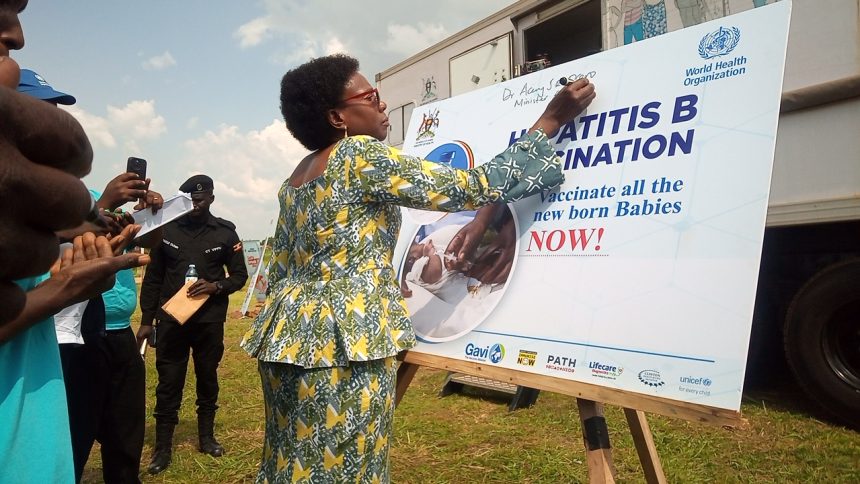
Dr. Aceng made the remarks on last Friday during the launch of the Hepatitis B Vaccination Dose at Birth program at Acholi Bur Secondary School in Pader District.
She criticized leaders who divert communities from critical health issues saying their negative propaganda has contributed to low vaccination uptake.
“Most leaders tend to divert communities from health issues that directly affect them. Vaccination turnout has been low because many mothers neglect their children’s right to immunization once government programs are introduced,” Dr. Aceng Said.
The minister noted that Northern Uganda continues to bear a heavier disease burden compared to the rest of the districts in the country citing malaria, Hepatitis and cancer as major health threats, she said.

According to her, the prevalence of Hepatitis B in Northern Uganda stands at 9% more than double the national average of 4%.
She attributed this to the reluctance of some community members to seek services early despite government efforts.

Recalling the 2014 National Survey, Dr. Aceng said Hepatitis B was found to be a “silent killer” in the region with many people completing the first vaccine dose but failing to return for the 1st and 3rd doses.
“This drop-out was largely fueled by propaganda from some leaders who discouraged vaccination. Leaders must change their mindset and encourage parents to vaccinate their children at all stages. Ironically, some politicians who spread anti-vaccine messages have privately vaccinated their own children using propaganda only to win votes”, She added.
Dr. Aceng praised communities in Lango sub-region for embracing vaccination and urged leaders in Acholi and beyond to follow the suit.
Professor Dr. Ponsiano Ocama, Supervisor of Clinical Services for Hepatology at Mulago National referral and teaching hospital, advised communities to avoid risky practices that spread the transmission.
He added that everyone should seek for checkup, adding that every week 2 to 3 patients are diagnosed with advanced liver cancer, urging that there is need to test and follow what the doctors tell us.
“Sharing, sharp objects are one of the main ways Hepatitis B spreads. Out of every 100 patients diagnosed, 80% have Hepatitis B”, Prof. Dr. Ocama said.
Dr. Benson Oyoo, the Acting District Health Officer of Pader said the district continues to face a significant Hepatitis B challenge.
He made the remarks as the district joined the World in Commemorating World Hepatitis Day marked every 28th July under the theme “Let’s break it down”.
He emphasized that the day is not only about raising awareness but also about honoring those who have lost lives to the disease standing in solidarity with those living with it and reaffirming commitments to eliminate Hepatitis as a public health threat.
According to Dr. Oyoo, Hepatitis B prevalence in Pader has risen to 5% above the national average of 4.4%.
He revealed that many people live with the disease unknowingly as it silently damages their livers eventually leading to death and loss of productivity.
Out of 5,346 people screened, 4,921 were tested and 244 were confirmed positive representing 5% of those tested. Among the positives 51% were female and 49% male. Additionally, 1,940 people were vaccinated during the campaigns.
Most positive cases were recorded among people aged 24 years indicating both a knowledge gap and need for more targeted community health education.
“Despite the challenges, the ministry of health has supported us with training of health workers, awareness campaigns on radios, free screening and treatment services and now the launch of the monovalent Hepatitis B vaccines to be administered at Birth,” Dr. Oyoo said.
He added that during the district outreach activities, an integrated approach was used, clients were screened for Hepatitis B, Hepatitis C, HIV and Malaria while those who tested negative were vaccinated and positive clients were linked to Pajule Health Centre IV for further management.
Dr. Oyoo however highlighted major challenges affecting the fight against Hepatitis B in Pader including inadequate test kits for Hepatitis C and HIV, limited supply of Hepatitis B vaccines and poor road networks hindering community access to health facilities.
Pader District has a population of 240,159 people spread across two constituencies, 18 sub-counties and 5 town councils with 97 parishes. However, the district has no district hospital. 9 sub-counties lacks a HCIII and 4 of those have no Health facility at all, creating a heavy burden on the few existing Health Centres.
At Pajule Health Centre IV which is the district’s highest level facility, maternity services average 120 deliveries per month while daily Out Patient attendance average 170 patients yet the facility has only 2 delivery beds and limited structures.
Dr. Oyoo called on the Ministry of Health to upgrade Pajule Health Centre IV into a district hospital and to fast track the upgrade of Awere HCIII to a Health Centre IV to serve Aruu Constituency.
Fearless Obwoya, the LC5 Chairperson of Pader District echoed that Pajule HCIV has only 2 delivery beds and most Health Centers in the district lack Maternity Wards.
“We need urgent upgrades to handle the patient load including those those referred from neighboring districts”, Obwoya said.
He also appealed for increased staffing and wage allocations to allow for the recruitment of additional health workers.
The commemoration of World Hepatitis Day in Pader highlighted both the progress made and the significant gaps that remain while vaccination campaigns and community outreaches have improved awareness and prevention though the district still grapples with high infection rates, inadequate infrastructure and resource constraints.
Dr. Aceng however concluded by urging leaders to work together with government to eliminate misinformation to strengthen public health services from preventable diseases.
“Leaders must engage communities constructively and avoid propaganda. Health is not politics our people deserve protection”, she stressed.