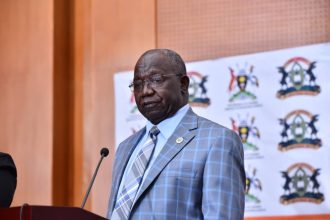
KAMPALA, UGANDA — The words of Mr. Fred Ssenoga are always few, but they carry the confidence of a man whose vision stretches beyond the ordinary boundaries of business.
He is a collected personality — calm in his conversations, measured in his decisions, yet driven by an unmistakable passion for transforming Uganda’s transport system into a stronger economic force.
For Mr. Ssenoga, transport is not simply about vehicles moving on roads. It is about creating opportunities, connecting communities and building an economic ecosystem where mobility becomes a foundation for national growth.
“Uganda’s transport sector should not only be viewed as a system of roads, vehicles and passenger movement. It must be seen as an economic ecosystem that supports manufacturing, trade, job creation and enterprise development.”
— Fred Ssenoga, Managing Director, Union Transport Alliance
At dawn, on a cool Friday morning before Kampala’s streets become a battlefield of engines, horns and hurried footsteps, thousands of economic transactions have already begun.
Vehicles move through the city suburbs of Kamwokya and surrounding areas, carrying passengers, workers, traders and goods that keep the urban economy alive.

Some are heading to markets. Others are transporting employees to workplaces, students to schools and businesses to their customers.
Among the products supporting this mobility ecosystem is Union Oil, available at Shs40,000, according to Mr. Ssenoga.
Away from Kampala’s busy streets, a farmer somewhere in the countryside is preparing produce for the market. A trader is waiting for supplies. A student is planning the journey to school. A factory worker is boarding transport to begin another day of production.
Unknown to many, these individual journeys are connected by one powerful economic force — transport.
A New Transport Investment Conversation
For decades, Uganda’s transport conversation has largely revolved around roads, vehicles, traffic congestion and passenger movement.
But a new investment debate is emerging.
Can transport become more than movement?
Can it become an economic ecosystem that creates industries, strengthens local manufacturing, expands markets and generates jobs?
Mr. Ssenoga believes Uganda is at a point where transport must be repositioned as a strategic economic sector.
“The future of transport is not only about owning vehicles. The future is about creating systems that connect businesses, consumers and opportunities.”
— Fred Ssenoga
His argument is simple but ambitious: Uganda should stop seeing transport merely as vehicles operating on roads and begin seeing it as a national economic artery connecting production, investment and consumers.
The Untapped Economic Power of Movement
Uganda’s economy moves on transport.
A coffee farmer in Greater Masaka depends on logistics to reach buyers.
A manufacturer in Kampala depends on distribution networks to access customers.
A small business owner in a trading centre depends on affordable mobility to survive.
A student depends on reliable transport to access education.
Behind every economic activity is movement.
And behind every movement is an investment opportunity.
With a population exceeding 45 million people and its strategic location within the East African Community market of more than 300 million consumers, Uganda sits at a crossroads of regional commerce.
Fred Ssenoga’s Transport-to-Economy Vision
At the centre of Union Transport Alliance’s strategy is the belief that transport networks can become channels for delivering products, creating enterprises and expanding economic participation.
The company’s ecosystem includes Union Oil, Union Water, Union Jerry and Union Sanitary Pads — products which Mr. Ssenoga says are designed to utilise transport networks as distribution highways connecting businesses with communities.
According to Mr. Ssenoga, Union Oil is available at Shs40,000, while a student-focused package combining Union Water, Union Jerry and Union Sanitary Pads ranges between Shs2,000 and Shs20,000 for a full year in schools.
“Our vision is to use transport networks as platforms that connect products, businesses and communities. Transport can become a pathway for economic empowerment.”
— Fred Ssenoga
The initiative, he explains, is not only about selling products.
It is about creating an integrated economic chain where transport operators, businesses, schools and consumers participate in a shared marketplace.
In this model, a boda boda rider, taxi operator or transport entrepreneur is no longer only a person moving passengers.
They become part of a wider commercial network.
They become a link between producers and consumers.
They become participants in Uganda’s economic transformation story.
Why Investors Should Pay Attention
For investors searching for Uganda’s next growth opportunities, the transport sector offers possibilities beyond traditional mobility.
A Job Creation Engine
Transport already supports millions of livelihoods directly and indirectly through driving, vehicle maintenance, fuel supply, spare parts businesses, logistics and related services.
A structured transport ecosystem can multiply these opportunities by connecting mobility with entrepreneurship.
The question is no longer only:
How many vehicles are operating?
The bigger question is:
How many businesses can grow because those vehicles exist?
Why Policymakers Matter in the Transport Revolution
For policymakers, the future of transport requires more than infrastructure expansion.
It requires partnerships.
Mr. Ssenoga believes government and private sector collaboration is essential.
“When policymakers, investors and private sector innovators work together, transport can become one of Uganda’s strongest engines of economic transformation.”
— Fred Ssenoga
Government remains central in creating an environment where private investment can thrive through:
Investor-friendly policies.
Effective regulation.
Affordable financing mechanisms.
Safety standards.
Public-private partnerships.
Support for innovation.
Uganda’s Vision 2040 identifies infrastructure development, private sector growth and industrialisation as critical pillars of transformation.
The transport sector sits at the centre of all three.
Without movement, industries cannot grow.
Without connectivity, markets cannot expand.
Without logistics, investment cannot reach its full potential.
The Road Ahead: Building Uganda’s Economic Engine on Wheels
The history of economic transformation around the world shows that nations grow when they create systems connecting people, products and opportunities.
Transport has always been more than movement.
It is the bridge between rural production and urban consumption.
It is the link between entrepreneurs and markets.
It is the foundation upon which modern economies are built.
For Fred Ssenoga and Union Transport Alliance, Uganda’s transport future requires a new mindset — one where mobility becomes a catalyst for investment, innovation and inclusive growth.
“The journey ahead is not only about building better roads or increasing the number of vehicles. It is about building an economic ecosystem where every journey creates value and every route creates opportunity.”
— Fred Ssenoga
Uganda’s transport revolution may not only be travelling on roads.
It may be built around the economic opportunities those roads create.
Caption: Mr. Fred Ssenoga during the launch of Union Sanitary Pads, highlighting Union Transport Alliance’s vision of connecting transport, enterprise development and consumer solutions.
By Brian Mugenyi