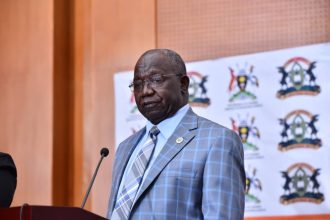

The appointment of Anita Rukundo marks the establishment of formal consular ties for The Bahamas in Uganda, aiming to foster bilateral relations, tourism, and trade between the two nations. The appointment was announced on Monday 18th 2026 by Bahamas diplomat Jerusa Léa Ali, who said the two first met during the G77 and Non-Aligned Movement summits hosted by Uganda in 2024.
According to Ali, the appointment is intended to strengthen consular services, trade, and investment ties between Uganda and the Caribbean nation.
The Ugandan government is now so strict and it keenly assesses and evaluates whoever is tipped for appointment of honorary consul by a sending state. The Uganda Government now takes its time to study and assess those persons before they respond back to the sending state.
Honorary consuls are typically unpaid representatives tasked with promoting bilateral relations, assisting citizens abroad, and facilitating business and investment opportunities. Such positions are often awarded to prominent businesspeople or individuals with strong local networks.
Officials indicate that Anita Rukundo first expressed interest for the appointment of honorary consul of Bahamas to Uganda in June 2023, and luckily enough, Bahamas officials would attend the January 2024 G77 Summit in Uganda and used that opportunity to meet her. Anita is such a jolly and humble leader, and Ugandans are happy for the appointment.Since 2024, she has patiently followed the diplomatic processes of the Bahamas Ministry of Foreign Affairs, and today she has been confirmed as the Honorary Consul.

Many Ugandans congratulated the Tayebwa family, especially Anita Tayebwa. The Bahamas, widely known for its offshore financial services sector and tourism-driven economy, maintains limited but growing engagement with African countries. Whether the new honorary post will yield tangible trade and investment benefits for ordinary Ugandans remains unclear but its clear that Anita is a dedicated leader.
Uganda hosted the 19th Non-Aligned Movement (NAM) Heads of State Summit and the Third South Summit of the G77+China back-to-back in January 2024 at the Speke Resort Munyonyo in Kampala. The back-to-back gatherings brought together over 5,000 delegates and dozens of heads of state to address Global South priorities, with Uganda assuming the NAM chairmanship through 2027.

The 19th NAM Summit was held January 15–20, 2024, under the theme “Deepening Cooperation for Shared Global Affluence.” The focus centered on solidarity, resolving geopolitical imbalances, and promoting economic self-reliance among developing nations. The Third South Summit (G77+China) was held January 21–23, 2024, under the theme “Leaving No One Behind,” where discussions concentrated on trade, climate change, and international financing for developing countries.
HOW ARE HONORARY CONSULS APPOINTED -PROCESS
The entire appointment process for an Honorary Consul typically takes 12 months though it can occasionally stretch up to years.The timeline largely depends on the administrative efficiency of the sending and receiving governments and how long it takes to clear the required background checks.The process unfolds in several standard phases which are The Appointment and Screening Process which can be ove six months.This is when the sending country (the foreign government) conducts internal vetting, verifies your business background, and confirms your local ties to the region.Actionability:
Step two is Requesting Agreement taking like 4 months and Once you are selected by the sending country, their Ministry of Foreign Affairs will request formal consent (also known as the agreement) from your home country’s government (the receiving state).
Step three is Issuing the Exequatur and thus is a process of 3 months or more.After both countries agree, the sending government issues a Letter of Consular Commission. Your home country then officially grants you an Exequatur, which is the legal authorization allowing you to perform your consular duties and receive official diplomatic privileges.Diplomatic and consular appointments are formal public processes.They are not private transactions,not commercial services, and not outcomes. Whether the role is a career ambassador, a diplomatic officer, or an honorary consul, the legal authority comes from governments acting under domestic law, international law, and bilateral practice.
Every appointment begins with the sending state, meaning the government that wishes to appoint a representative. For honorary consular appointments, the sending state may consider a private citizen with strong local ties, professional standing, cultural or language knowledge, and a reputation that reflects appropriately on the appointing state. But the key point is the same: the decision begins with the government.
Step 2 involves Agrément for ambassadors
Before a proposed ambassador is formally appointed, the sending state must usually request the agrément, or prior consent, of the receiving state. Article 4 of the Vienna Convention on Diplomatic Relations reflects this requirement.The process is confidential and diplomatic in character. The sending state communicates the proposed name through official channels. The receiving state reviews the proposal and may accept or refuse. It is not required to give reasons for refusal.This stage demonstrates the central role of host-state consent.Consent cannot be demanded, pressured, purchased, or guaranteed by a private actor. Demanding, pressuring in most cases lead to disqualification of the process.
Step 3 involves Exequatur for consular officers.For consular appointments, including honorary consuls, the equivalent concept is the exequatur or comparable authorization by the receiving state. Under the Vienna Convention on Consular Relations, a consular officer cannot exercise official functions in the host country unless the receiving state permits it.The sending state issues or transmits the relevant commission, and the receiving state decides whether to recognize the person for consular functions.If the receiving state does not grant authorization,the appointment has no practical legal effect in that territory.
The receiving state may also withdraw authorization. This reinforces the limited and consent-based nature of consular authority.
Step 4 is related to Credentials and commissions.Once the required consent has been obtained, the sending state issues the official documents appropriate to the role.For consular officers, the equivalent is generally a consular commission or letter of appointment, together with the host state’s authorization.Honorary consuls operate within the scope of that commission and authorization. Their authority does not extend beyond the functions recognized by the relevant governments.
Step 5 is about Notification and registration.After credentials are presented or authorization is granted, the receiving state’s Ministry of Foreign Affairs is notified and the person is entered into the relevant diplomatic or consular list. These lists are important because they record who is officially recognized in the host country.
Legal privileges and immunities depend on proper status, notification, function, and recognition. They do not arise from a business card, a title used privately, a marketing claim,or a passport document standing alone. The receiving state’s recognition is central.
A conservative advisory model must therefore be built around refusal discipline. Matters involving sanctions exposure, politically exposed persons, source-of-funds concerns, document-integrity issues, bribery risk, multiple pursuits for honorary consuls appointments on different countries,misrepresentation, or reputational sensitivity should be screened carefully and declined where appropriate.
Government discretion is the rule
Across every stage – nomination, agréement, exequatur, issuance of credentials,notification, and registration – the decisive authority belongs to governments. This is not an administrative detail. It is the core of the system and no short cut in the process.
Governments may accept, refuse, delay, or revoke. They may change policy. They may ask for additional information. They may decline without explanation. The uncertainty is not a defect; it is an expression of sovereignty.
For this reason, responsible commentary should avoid language such as obtain, secure, fast-track, acquire, arrange, or guarantee when describing appointments or official documents. Safer and more accurate language is: understand the framework, prepare information, assess suitability, identify risks, and recognize that competent authorities decide.
Diplomatic and consular appointments remain important tools of international relations.Honorary consuls can support consular access, trade, culture, and community links in locations where a full mission may not be present.
The legitimacy of these roles depends on state authority, transparency, and compliance with legal limits. They should not be presented as personal mobility products, immunity tools, or commercial status opportunities.