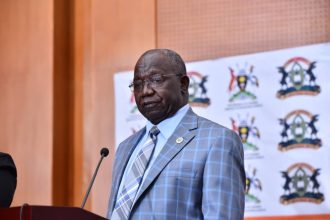
President Yoweri Museveni’s recent address at the Mbale State Lodge has triggered a storm of online backlash, satire, and misinformation across Uganda, Kenya, East Africa, and even beyond the continent. Snippets of the speech—especially those touching on access to the Indian Ocean—have been clipped, shared without context, and sensationalised to suggest that Museveni was declaring territorial claims or threatening Kenya.
But a closer, honest look at the full address reveals something entirely different.

A Speech About Integration, Not Invasion

President Museveni was not talking about annexing the Kenyan coast or claiming private ownership over the Indian Ocean. His point—stretching back decades in his political philosophy—is that Africa’s current political fragmentation weakens it economically, industrially, and militarily.
“When you are in a block of flats,” he said, “the compound belongs to the whole block. There is no way you can say it belongs only to the ones on the ground floor.”
This was not a threat. It was an illustration. Museveni was emphasizing that African nations—especially in East Africa—should view shared infrastructure, trade routes, and strategic resources as collective opportunities, not individual fortresses.
The Real Message: Africa Must Unite or Stay Weak
Throughout the speech, Museveni returned to one argument: size matters in global power. Nations that dominate in space exploration, global security, and major technological leaps are large, integrated, and economically cohesive.
“You fellows, you are here on Earth,” he joked. “Those fellows are on the moon looking at you like insects. I don’t like to be in that situation.”
This was vintage Museveni: part humour, part frustration, and part strategic warning. He was pointing to the reality that the United States, China, India, and Russia didn’t reach the moon as small, isolated states. They did so as unified, industrial, continent-scaled entities with massive economies behind them.
Museveni’s argument was simple:
East Africa cannot compete globally unless it integrates economically and, eventually, strategically.
A Call for Security Cooperation
Another critical part of his speech that was cut out in many viral clips was his analysis of global defense trends. The U.S., Russia, and China are not only competing on land, air, and sea—they are expanding into space, cyber warfare, AI, and extraterrestrial technology.
“How do we defend ourselves?” he asked. “Americans want to be superior on land, in the air, at sea, and even in space. Size matters.”
The message was not that Uganda wants to build a navy tomorrow. It was that regional unity would give East Africa a stronger bargaining position, greater deterrence capability, and more efficient resource-sharing.
No Kenyan territory was being claimed.
No military threat was being issued.
He was warning that small African states cannot survive future geopolitical realities if they remain small and divided.
Why the Indian Ocean Came Up
This is where the speech has been most misunderstood.
Museveni noted that landlocked countries like Uganda depend heavily on coastal nations for trade, pipelines, ports, and export routes. His “where is my ocean?” line was rhetorical—meant to highlight the irrationality of Africa’s colonial borders and the limitations they impose on modern development.
It was an argument for East African Community solidarity, not a challenge to Kenya’s sovereignty.
In his own words:
“Why don’t you look at East Africa? So that you deal with the issue of strategic security.”
A Misinterpretation Gone Viral
Unfortunately, because only short clips circulated online, many interpreted the remarks as:
- a declaration of war,
- a demand for Kenya’s coastline,
- or a critique of President William Ruto.
None of those interpretations reflect the speech’s content. Instead, Museveni was making one of his long-standing Pan-African appeals—this time given extra urgency by global instability and rising geopolitical competition.
The Bottom Line
President Museveni’s Mbale speech wasn’t about beaches, borders, or battles.
It was about integration, security, and Africa’s future seat at the global table.
The viral storm around it shows how easily context collapses in the age of short clips and social media humour. But beneath the noise is an old argument that African leaders—from Nyerere to Nkrumah—made repeatedly:
Africa must unite, or Africa will remain weak.
And that, in essence, is all Museveni was saying.