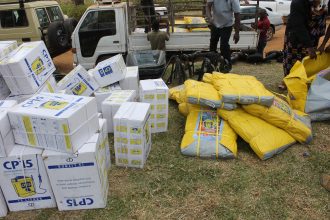
Agricultural experts in Kisoro District have called on Irish potato farmers to embrace positive seedling selection within their gardens, rather than sourcing seeds from market centers, in a bid to improve both the quality and quantity of yields.
The appeal was made by Kamari Fideri, Chairperson of the Kisoro District Potato Growers Cooperative Union, during a media briefing held at his office in Kisoro Municipality. His remarks come amid peak seedling trade season across the Kigezi region, where many farmers continue to depend on open market sources for seed.
Kamari emphasized that farmers should identify and retain healthy seedlings directly from their gardens for future planting. He warned against the risks of market-sourced seedlings, noting that their origin, health status, and quality are often unknown, resulting in lower yields and spread of disease.
He further advised farmers to use certified local seed varieties, and cautioned against adopting foreign potato varieties that are not approved by Uganda’s Ministry of Agriculture, Animal Industry and Fisheries (MAAIF). These imported varieties, such as Rwangume, often underperform and introduce additional challenges.
“Rwangume is a variety from Rwanda and is not certified under Uganda’s seed systems. In Rwanda, they clean this seed annually to maintain performance. Unfortunately, this is not done in Uganda,” Kamari noted.

Kamari also observed that long-standing reliance on varieties like Rwangume and Kinigi has led to their degradation due to overuse, further contributing to declining yields in the region.
Instead, he encouraged farmers to obtain high-quality, clean seeds from research centers such as Kachwekano Zonal Agricultural Research and Development Institute -KAZARDI, where new, high-performing varieties have been introduced.

CUE IN……………..KAMARI
Local potato trader Pastor Twesiime Abel supported Kamari’s sentiments, blaming the dependence on market-sourced seedlings for the introduction of poor-quality varieties, which negatively affects both yields and market prices. He also highlighted the rising operational costs in the potato value chain, especially in connecting farmers to buyers.
CUE IN…………….TWESIIME
Farmers such as Fred Baryayasanga from Nyarusiza Sub-county acknowledged the growing concern, noting that continued use of the same seed varieties season after season has resulted in reduced productivity.
Meanwhile, Buturo Richard, a farmer from Nyanamo Town Council, called on the government to provide more support for irrigation systems, particularly during the prolonged dry spells which have severely impacted crop production.
CUE IN……………….FARMERS ON VOXPOP
Kisoro has long been a leader in Irish potato production in Uganda’s Kigezi sub-region. However, experts now warn that the district is being overtaken due to unsustainable farming practices, excessive crop rotation, and overuse of artificial fertilizers that have degraded soil fertility
The decline in productivity has raised concerns among stakeholders, as Irish potatoes are both a key staple food and a critical income source for many households in the region. Districts such as Kabale, Rubanda, Rukiga, and Kisoro contribute more than 60% of Uganda’s total potato production, with annual national output estimated between 800,000 to 1,000,000 metric tonnes.
Outside of Kigezi, Irish potatoes are grown in the Bugisu sub-region, as well as Mubende and Mityana. Ideal farming conditions include cool temperatures (10ºC–23ºC), well-drained loamy soils, and altitudes between 1,500–3,000 meters. In areas such as Kabale and Mbale, these conditions are naturally met, while in places like Mubende, potatoes grow in moderately stony but fertile soils.
Common potato varieties in Uganda include, Rwangume and Kinigi (popular but increasingly exhausted), Nakapot 5, Kachwe 1, Rutuku, And the disease-resistant Victoria.
Irish potatoes are a high-value cash crop in Uganda. A farmer investing shillings 2 million per acre can earn up to UGX 15 million, with yields of up to 15 tonnes per acre.
Urban demand for potatoes, especially for chips and crisps, continues to rise. While farm-gate prices are around shillings 200,000 per 100 kg sack, the same sack fetches over shillings 350,000 in Kampala and other urban markets.
According to a 15-year study by RUFORUM (Regional Universities Forum for Capacity Building in Agriculture), Irish potato yields have dropped from 7 to 4 tonnes per hectare over the last 7 years.
Researcher Prof. Jonny Mugisha of Makerere University attributes this decline to the recycling of seeds, where small tubers are replanted and larger ones sold, leading to declining seed quality.
The current estimated national demand is over 850,000 MT annually, and is expected to increase by 50% due to urbanization and population growth, especially among youth populations.
Conclusively, Irish potato farming presents significant opportunities for Uganda’s agricultural sector. According to experts, to reverse the current decline in productivity, farmers must embrace sustainable practices, including, Positive seed selection, Use of certified seeds, Crop rotation, and investment in irrigation.
With rising demand and favorable conditions, Irish potatoes remain a profitable and resilient crop that can help transform rural livelihoods and contribute to Uganda’s food security and economic development.