By Evans Najuna
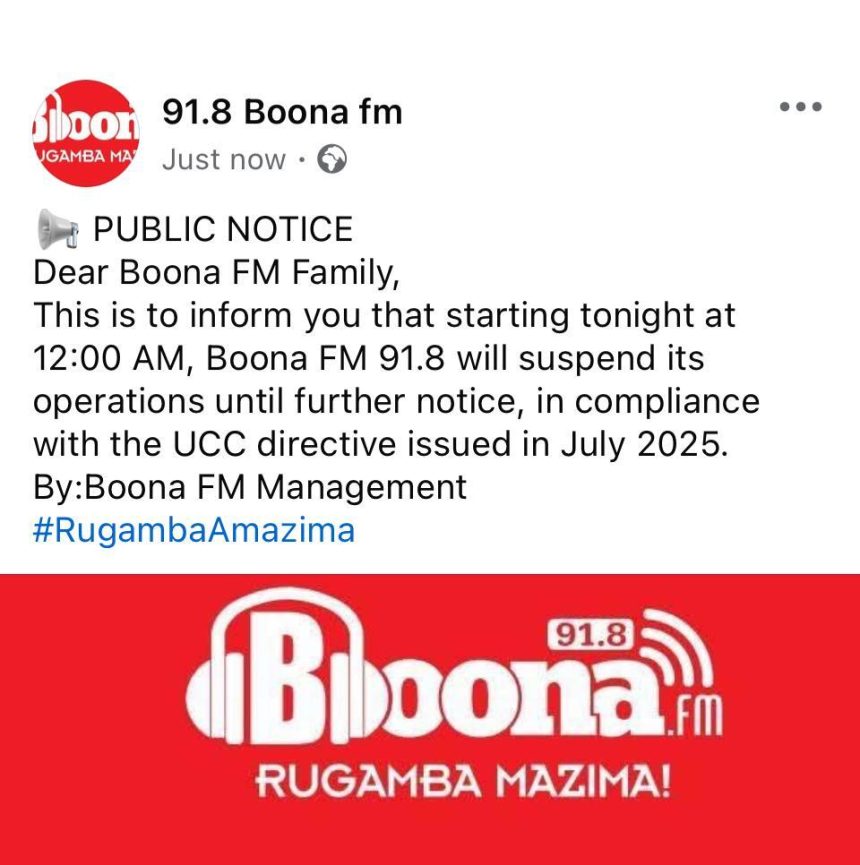
On the evening of Thursday, September 12th, this week, news about the closure of Rukungiri’s widely listened-to radio station (91.8 Boona FM) started circulating on social media, which its supporters, fans, and listeners couldn’t believe.
This was after its management had already placed announcements on both airwaves and social handles that it would be off-air until further notice. This prompted several social media netizens to spread the news like wildfire.
This development comes at a time when the country and the entire population are gearing up for the 2026 general elections. Rukungiri’s son of the soil and media personality, *Evans Najuna*, aka _Vanlogs_, digs deeper into the reasons behind this action, exploring why it could be a political miscalculation by Rukungiri’s political players.
Lifeline of Radio Communication in Uganda’s Politics

Historically, before and after independence, Uganda was predominantly occupied by one government-owned airwave known as Radio Uganda. Its signal frequency covered the whole country and neighboring countries. This was primarily a government mouthpiece, mainly to promote government programs. From a political point of view, radios act as a means of spreading political propaganda. This means that for any government or leader to thrive politically, they must be in full control of all communication channels in their territory of administration. Automatically, this helps advance governance operations, communication, and the total flow of information. Therefore, this is the reason why every leader who has punched their way into the country’s administration has to first focus on state-owned communication channels, which have been mainly UBC but the sector has since been liberalised.
Genesis of Radio Political Forces in Rukungiri

As stated earlier in the preamble, Uganda had only one government radio station (UBC). However, seven years after NRA liberation, the country saw the emergence of FM radio stations. Among the pioneer FM stations in Western Uganda was 96.9 FM Radio Rukungiri (the Voice of Development), established in 1997. It is still located in Rukungiri District town and is owned by Hon. Gen. Jim Muhwezi, the Rujumbura Member of Parliament. Three decades later (in 2017), another FM station, 91.8 Boona FM, was launched. It was allegedly and reportedly owned by Rukungiri businessman Wenceslas Manige until recently, when it started to reveal that the former Rubaabo Member of Parliament, Hon. Mary Paula Turyahikayo, controls a larger shares of the station.
It is said that the birth of Boona FM in 2017 in the district started exerting a lot of pressure, to the extent that its proprietor nicknamed it “Radio eyabariya abakye” – the radio of minority people/audience. What started as a business-like rival competition later turned into a political cold war. Political pundits have since revealed that these political fights began when Gen. Jim Muhwezi was politically docile, after a mega political humiliation by FDC to the ruling party NRM in the 2016 general elections, which saw FDC sweep all the parliamentary slots, leaving only Hon. Mary Paula Turyahikayo in Rubaabo as the NRM kingmaker in the district, who did not have any political foes, unlike Hon. Winnie Matsiko, who was later ousted in a hotly contested election by FDC’s Hon. Betty Bamukwatsa Muzanira.
It is alleged that during this period, Radio Boona was fighting Gen. Jim Muhwezi, and Radio Rukungiri was fighting Hon. Mary Paula. Meanwhile, the staff of Radio Rukungiri worked tirelessly to maintain their relevance and the radio’s supremacy while decampaigning Hon. Mary Paula during the time when the radio’s proprietor was politically docile. This has been described as a business bruise to the radio station, which lasted until the proprietor returned to parliament in 2021. It is revealed that during that political break, Radio Boona explored its business favors, hence dominating the audience in southwestern Uganda, and the rival station turned to call itself a community radio station (not for business), since it was thriving as a political orphan while the proprietor was politically docile.
The dust kept rising to the extent that when Radio Boona started hosting the founder of the Western Uganda Boona Bagigahare Nyekundire group, Peace Rugambwa, who was and still is referred to as Jim’s political nemesis. Political analysts then described it as a case of turning a deaf ear. But this escalated to the extent of suffocating the minister, causing him to lose his grassroots support in parts of the Rujumbura constituency, particularly Bwambara, Bugangari, and Buhunga Sub-Counties – three out of five Sub-Counties in his constituency. This development has been described as a political bloody nose heading into the 2026 elections.
Onlookers say that the dust kept on as Radio Boona continued with the provocation, showcasing more creativity that was orchestrated by Kacene’s talent and way of doing things. It’s said that Kacene, who doubles as Radio Boona’s station manager, created Studio B, giving space and air to the minister’s political opponents, especially the likes of Peace Rugambwa, in addition to the weekly program every Saturday morning known as “Ishaazi”. This kept giving the minister more headache, as he had already eliminated them access from constituents after their famous interface with President Museveni at State House.
It is said that Kacene’s tactics kept haunting the powers that be, as he fought political wars on behalf of his boss, Mary Paula. During the same time, there was a blessing in disguise at the administration of the Uganda Communications Commission (UCC), with the appointment of Hon. Nyombo Tembo as the new Executive Director of UCC. Pundits have since described the relationship between Gen. Jim Muhwezi and Hon. Nyombi as comradeship, given that they are both NRM members and were formerly in the 7th, 8th, and 9th Parliaments, and also served together in the cabinet.
Using this advantage, it is revealed that petition letters started flying into the UCC Executive Director’s office, seeking to look into the operations of Boona FM, which was giving the minister and Rujumbura constituency MP headaches. This was later followed by UCC summoning and inspecting the operations of the said station. Political pundits have added that this was comradeship at play.
Why shut down now?
Political analysts have insisted that after the NRM primaries and prior to the party structure elections, Gen. Jim Muhwezi felt comfortable underestimating his performance in the NRM CEC elections, where he was contesting as the incumbent Chairperson of the Veterans League, to which he lost miserably to Lt. Mushabe from Isingiro District. In a bid to consolidate this and remain politically relevant at the national level, it has been said that the former NRM/A historical figure was only concerned with how to secure his parliamentary seat, hence reigniting the three major obstacles; how to control the level of spreading his political propaganda (hence closing Boana FM), how to reconcile with his NRM political opponents and consolidate the grassroots, and how to deal with the opposition ahead of 2026.
Indeed, this was seen earlier in the same week as the minister was seen reconciling with his closest challenger in the recently concluded NRM primaries, Hon. Frank Arinaitwe Rukanirwa. This event was facilitated by NRM’s Vice Chairman, Al-hajji Moses Kigongo. And the following day, reconciliation was extended to the grassroots on the same day that Radio Boona announced its shutdown after being ordered by UCC in a meeting.
Conclusively, the closure of Boona FM in the politics of Rukungiri District is still being monitored along three dimensions: the group commanded by Hon. Mary Paula Turyahikayo and Ex-army spy Lt. Gen. (Rtd) Henry Tumukunde with their associates, another group commanded by the Rujumbura MP, Maj. Gen. (Rtd) Jim Muhwezi, and the Besigye faction (PFF), which once dominated the district’s leadership.
Views from the Ground
Apparently, both locals and elites within and outside the district supporting the different sheds of political vehicles are singing drums of revenge inside the ballot box. Many have since described it as a political miscalculation in trying to sabotage one another in political games. This will ultimately affect the 2026 elections, putting other issues aside, like the incursion of Dr. Besigye and the disappearance of Sam Mugumya.
An insider who preferred anonymity has revealed that Jim could have been angered by the September 6th Boona’s political program, known as Ishaazi, which on the same day hosted two Rubaabo NRM contenders (Hon. Bob Rugonde and Mathius Rwabugumi) while Jim was on Radio Rukungiri. After the 3-hour show, social media propagandists started trolling him as a political liability, saying he was not being listened to after spending a total of 3 hours on air while Boona was enjoying a higher percentage of the audience. Team Jim didn’t take this lightly, but rather as a political embarrassment, when his opponents call him Rukungiri’s political liability.
Relatedly, some political scholars within and outside the district are saying that, much as apparently there’s a resemblance of two NRM fighting factions in Rukungiri, the ultimate reality is that they can’t all win. Therefore, at the end of the day, there will be a winner and a loser. In this scenario, they are more assured that whoever wins will automatically secure a ministerial position. Others have also alluded that the political players who happen to be the owners of Boona FM seem to be ready to sacrifice the station for the sake of a sympathy win in the coming elections.
In trying to understand the impact of Lt. Gen. (Rtd) Henry Tumukunde’s involvement in the politics of Rukungiri, most residents seem uncomfortable with him because he has been part of the circle of power, and they question what contribution he will make to the development of the district, rather than just clinging on for relevance in national politics. While others believe he will be able to dismantle the long-standing self-proclaimed kingmakers in the politics of the district, both NRM and opposition.
The closure of Boona FM is a complex issue with deep-rooted political undertones. It appears to be a strategic move in the ongoing political rivalry in Rukungiri, with implications for the 2026 elections. The development has sparked intense debate and speculation, with many wondering about the true motives behind the UCC’s actions despite the denial of all political players. As the situation unfolds, one thing is clear; the stakes are high, and the outcome will likely have far-reaching consequences for the district’s political players and the wider community.
The closure of Boona FM is a significant development in Rukungiri’s politics, with potential implications for the 2026 elections. The situation demands close attention and careful analysis to understand the motivations and consequences of the closure.
The writer is _Evans Najuna_, aka _Vanlogs_: a Ugandan media personality, a political student of NRM/A style of politics and leadership, and a Rukungiri-born son of the soil.
Email: [email protected]