
KAMPALA, Uganda — The Uganda National Examinations Board has officially released the 2025 Uganda Advanced Certificate of Education (UACE) results at State House, marking a significant increase in the number of candidates who sat for the national examinations.
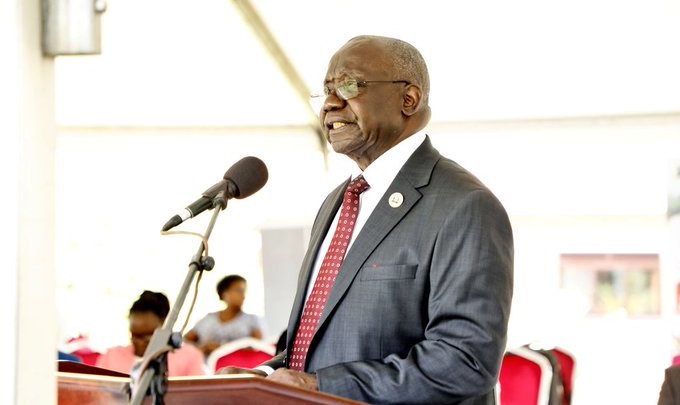
While announcing the results, UNEB Chairperson Celestino Obua revealed that 166,400 candidates registered for the 2025 UACE examinations, representing a 17.2 percent increase compared to 141,996 candidates registered in 2024. Out of the registered candidates, 165,172 students actually sat the examinations, which were conducted from November 10 to December 5, 2025, across 2,844 examination centres nationwide.
Prof. Obua noted that the overall performance of candidates remained steady, although there was a noticeable shift in subject preference, with more students choosing humanities subjects compared to science combinations.
Female candidates have continued to perform commendably better than their male counterparts, maintaining stronger performance grades at several subject levels in the Humanities and demonstrating lower overall failure proportions. Proportionally, females outperformed males at the principal level pass (A–E) in most Humanities subjects, as well as in Mathematics, Physics, General Paper, Subsidiary Mathematics, and Subsidiary ICT. This trend affirms the positive impact of continued investment in girl-child education.
However, at the top level of A passes, male candidates scored higher than females in Mathematics and Science subjects, while female entries in Sciences and Mathematics remain lower than male entries, reflecting the ongoing gender gap in these disciplines.
Special Needs Candidates also participated in higher numbers. A total of 540 Special Needs Education (SNE) candidates (274 males and 266 females) registered for the 2025 UACE examinations, up from 437 candidates (249 males and 188 females) in 2024.
In terms of gender distribution, 72,764 (43.7%) of registered candidates were female and 93,636 (56.3%) were male. Of those who sat the exams, 72,374 (43.8%) were female and 92,798 (56.2%) were male. While female participation remains lower than male participation, their performance continues to outshine males in many Humanities and mixed subjects.

The UACE examinations play a crucial role in determining students’ progression to universities and other higher institutions of learning, guiding admissions into competitive programs such as medicine, engineering, law, and technology.
The release of the results has generated widespread reactions on social media, with many users sharing stories of parental sacrifices, student determination, and humorous takes on exam anxiety and rumours about leaked papers.
Education stakeholders note that the growing number of candidates sitting the UACE exams reflects increasing access to secondary education, while also placing more pressure on universities to expand admission opportunities for Uganda’s growing student population.